An extinct species
Giant sea scorpion †
Jaekelopterus rhenaniae
A spider relative that could grow longer than a person
Lived about 400–395 million years ago.
You and the giant sea scorpion meet in the Two-sided animals branch, shown at about 580 million years ago (on 11 November, in a calendar from life's shared ancestor to today).
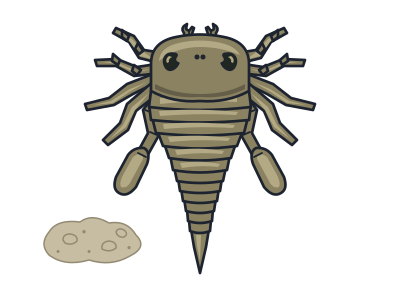
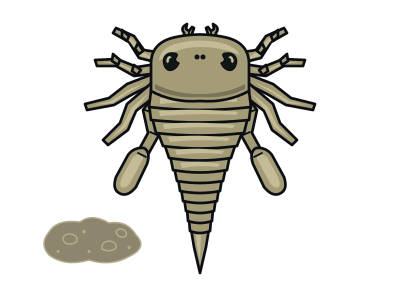
Longer than most people were tall, this sea scorpion could have ranked among the largest arthropods known. Arthropods are animals such as insects, spiders and crabs, with jointed legs and an outer body covering. It belonged to an extinct branch related to spiders, scorpions and horseshoe crabs—not a giant lobster. It lived about 400 to 395 million years ago.
Its famous size estimate came from an incomplete fossil claw, not a complete giant body. Researchers reconstructed one part of the claw as about 46 centimetres long, then used relatives’ body proportions to estimate the animal’s length. That gave a head-to-tail length of about 2.5 metres. The claw was real fossil evidence; the full length was a calculation.
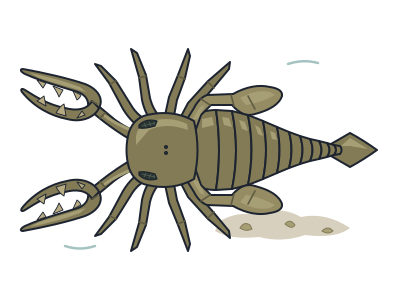
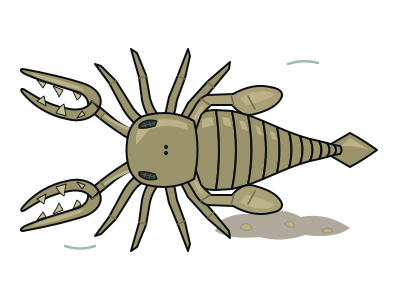
Despite its name, it did not necessarily live in the open sea. Rocks around the giant claw suggested a partly salty lagoon or a lake on a river delta. Its strong front pincers had curved fingers and teeth of different sizes. Their shape suggested gripping and crushing, while the arrangement of its eye lenses suggested sharp vision.
Thousands of lenses
Studied eyes contained about 3,000 tiny lenses each, though estimates varied between specimens.
Different family tools
Its fellow sea scorpion Eurypterus had much smaller pincers for handling food.
Paper-thin fossils
In its wider family, even large body plates could become paper-thin, flattened fossils.