An extinct species
Eurypterus †
Eurypterus remipes
A paddle-swimming relative of spiders, remembered as New York’s state fossil.
Lived about 423–419 million years ago.
You and the eurypterus meet in the Two-sided animals branch, shown at about 580 million years ago (on 11 November, in a calendar from life's shared ancestor to today).
A 2007 review called this paddle-equipped animal the most common sea scorpion in fossil collections, reporting more than 10,000 recovered specimens. It also became New York’s state fossil. Despite its name, it was not a true scorpion. It belonged to the same wider group as spiders and scorpions.
It lived about 423 to 419 million years ago, in shallow coastal waters in what are now New York and Ontario. Some Ontario fossils came from deposits where fresh water and seawater mixed. Other fossil-bearing rocks recorded salty conditions and periods of drying.
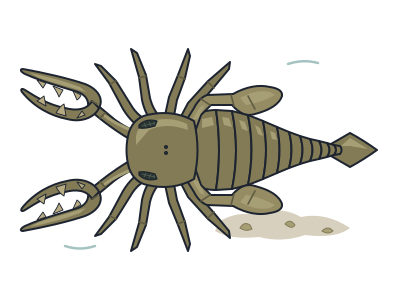
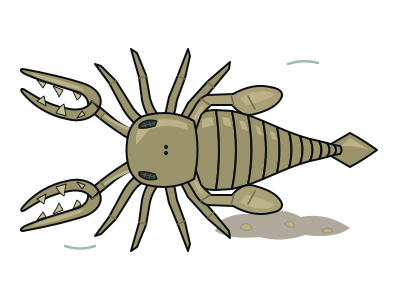
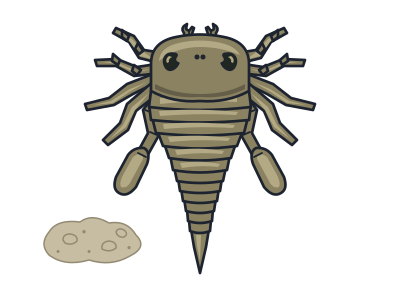
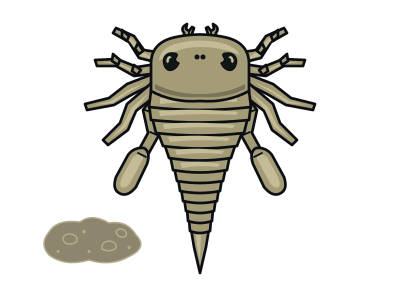
Fossils showed a broad head shield and a body that narrowed towards a long, pointed tail. Its head carried small mouth pincers, four pairs of walking legs and a pair of broad swimming paddles. Researchers interpreted its eyes and paddles as evidence of an agile hunter. That was a reconstruction of its way of life, not behaviour caught in a fossil.
Mistaken for a fish
Its earliest scientific description mistook it for a catfish.
Crowded stone
Some New York rock slabs preserved up to about 20 nearly complete specimens together.
Outgrowing its armour
It had to shed its hard outer skeleton to grow, as living joint-legged animals do.