A species
Glaucophyte
Cyanophora paradoxa
A pond microbe whose solar panels still wear the wall of the bacterium they once were.
You and the glaucophyte meet in the Eukaryotes branch, shown at about 1.8 billion years ago (on 28 July, in a calendar from life's shared ancestor to today).
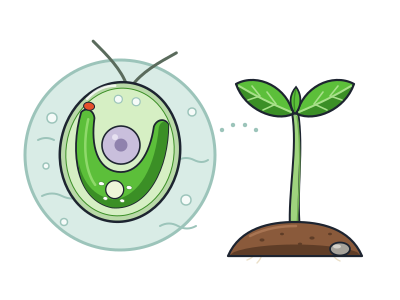
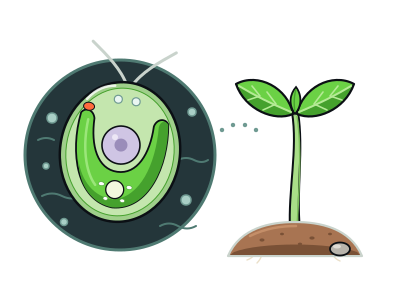
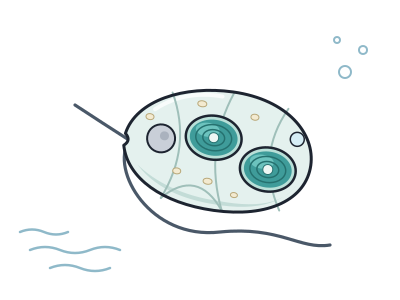
Inside this tiny pond swimmer sit one or two blue-green 'solar panels'. These are its chloroplasts, the parts that turn sunlight into food. They come from a free-living bacterium that was taken in long ago. Surprisingly, each one is still wrapped in a thin wall made of the same material bacteria use. It is built much like the wall of a common gut bacterium.
That makes this microbe a rare window on a very old event. Its own small group, the red algae and the green plants all come from one ancestor that took in a bacterium and kept it. Of those three groups, only this one still has a clear bacterial wall around its chloroplasts, though some mosses still carry genes linked to it. So the daisy in your garden and this pond microbe are relatives, and they share the same solar-panel story.
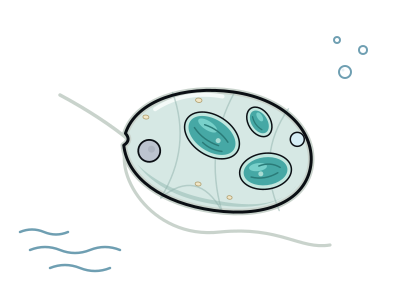
The cell is shaped like a tiny egg, far narrower than a human hair. It swims with two whip-like tails, one long and one short, pointing different ways. It looks blue-green rather than grass green because, as well as chlorophyll, it uses blue light-catching colours like those of the blue-green bacteria its chloroplasts came from. To make more of itself, it simply splits in two lengthways, even while it is swimming.
Found in a Ukrainian pond
A biologist working in Kharkiv, Ukraine, first described it in 1924 from a pond there. His paper was in Russian in a little-known journal, so other scientists overlooked it for many years.
A puzzling name
At first, scientists thought its green bodies were separate living things in partnership with a colourless cell. That puzzle is where its name 'paradoxa' fits in. Today we know they are true chloroplasts.
A very small family
Its group is by far the smallest of the three branches that also hold red algae and green plants. Only about 14 to 26 species have been described, and none of them is common in nature.