A species
European plaice
Pleuronectes platessa
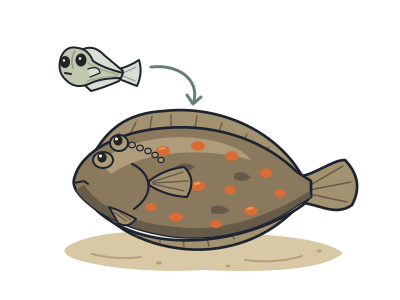
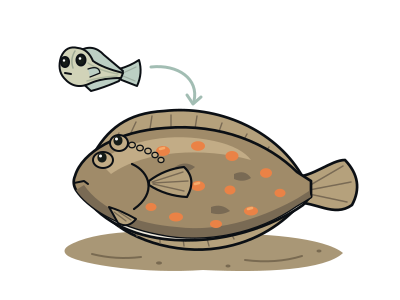
One eye changes sides as it grows.
You and the european plaice meet in the Bony fish and their descendants branch, shown at about 430 million years ago (on 24 November, in a calendar from life's shared ancestor to today).
A European plaice hatches looking like a familiar fish, with one eye on each side of its head. As it grows, its left eye moves across to join the right. The adult usually rests on its left side, not its belly. Both eyes can then look out above the seabed, rather than one being pressed against the sand.
Surprisingly, this flat seabed dweller belongs to the same broad branch of the fish family tree as swordfish. They are relatives, but not each other’s closest living relatives. Their very different shapes are a reminder that related fish need not look alike.
The upward-facing side is usually brown with orange or red spots; the underside is white. A plaice can adjust its background colour to match the seabed, though the spots often remain noticeable. It can also bury itself with only its eyes showing. Plaice generally become active at night and spend much of the day resting in the sand or mud.
Two kinds of teeth
Cutting teeth handle soft food, while teeth farther back crush harder material such as shells.
Half a million eggs
A female can produce up to about half a million eggs when breeding.
A bumpy clue
A row of four to seven bony bumps behind the eyes helps distinguish plaice from similar flatfish.