A species
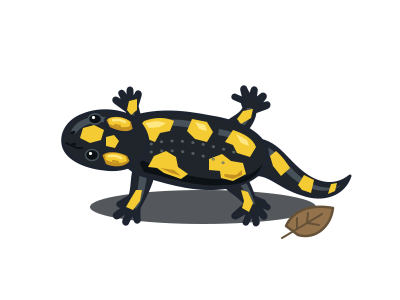
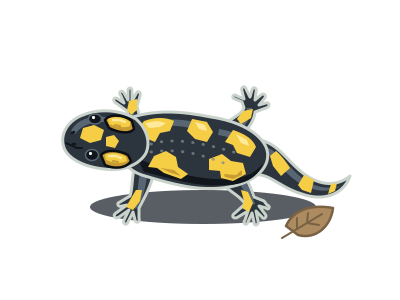
Fire salamander
Salamandra salamandra
Bright colours, a poisonous defence
You and the fire salamander meet in the Four-limbed animals branch, shown at about 350 million years ago (on 1 December, in a calendar from life's shared ancestor to today).
Black and yellow are warning colours on a fire salamander. They advertise the poisonous liquid made by glands in its skin. Large glands sit just behind its eyes, with more arranged in rows along its body. Its bright markings warn predators, but they do not guarantee that every predator will leave it alone.
Despite its lizard-like shape, this animal is an amphibian, not a reptile. It belongs to the same family as newts: newts are part of the wider salamander group. Adult fire salamanders live mainly on land, favouring shady woodland with ponds or streams nearby.
By day, a fire salamander can shelter beneath a log or rock, or inside a crevice. It is mainly active at night, when it hunts small animals such as insects, earthworms and slugs. That quiet, night-time life means people can live near fire salamanders without often seeing one.
Not always yellow
Some fire salamanders have orange markings. Yellow markings can form separate spots, broad patches or bands.
Not fireproof
Despite its name, a fire salamander cannot survive fire.
A surprisingly long life
Zoo Salzburg gives a lifespan of about 20–25 years.
Next to it on the tree
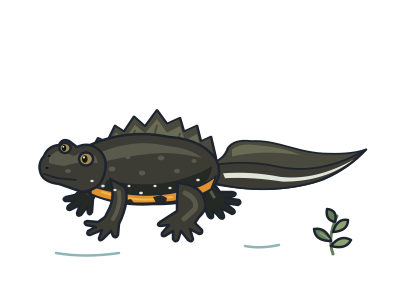
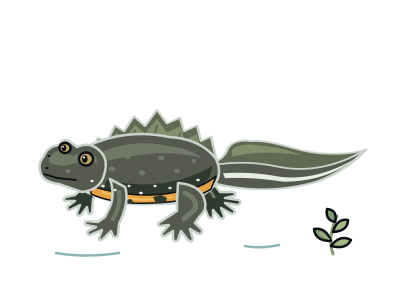
- Great crested newtMales grow a jagged crest like a tiny dragon during the breeding season.
- Eastern newtSpends its teenage years on land as a bright orange 'red eft' before returning to water.
- Rough-skinned newtCarries one of the strongest animal toxins, locked in an arms race with the garter snakes that eat it.