An extinct species
Eusthenopteron †
Eusthenopteron foordi
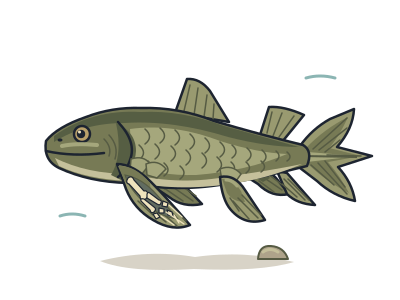
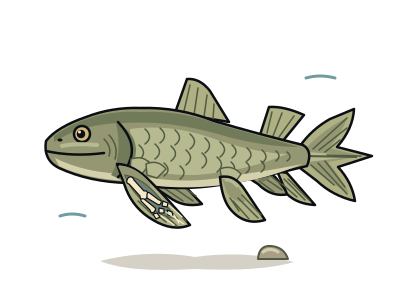
A fish with an arm-like pattern inside its fins.
Lived about 385–380 million years ago.
You and the eusthenopteron meet in the Fish on the way to land branch, shown at about 400 million years ago (on 27 November, in a calendar from life's shared ancestor to today).
Its front fins held a surprisingly familiar pattern: one upper bone, then two parallel bones, then several smaller bones. These matched the basic arrangement in your arms, including parts of your wrists. Fossil bones showed this resemblance, but the smaller bones were not fingers. Thin bony supports spread through the outer parts of its fins.
It lived about 385 to 380 million years ago. It was more closely related to four-limbed animals, including humans, than living lungfish or coelacanths were. That made it a close fish relative of ours, not a proven direct ancestor.
Despite those arm-like bones, it remained a water-dwelling fish, not a land-walking animal. Its paired fins were used for swimming, without hands or feet. The resemblance to our skeleton showed how much of the familiar arm-bone pattern was already present in a fish.
An inside connection
An opening connected the space inside its nose to the roof of its mouth, a feature shared with four-limbed animals.
Four fleshy fins
Its two front fins and two rear fins had fleshy bases. Each joined the body through a single internal bone.
Tiny youngsters
Some fossil youngsters were less than 5 centimetres long. Fossils of different sizes helped scientists study how it changed as it grew.
Next to it on the tree
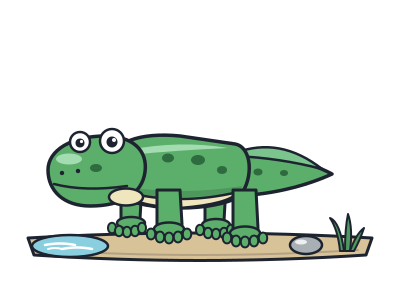
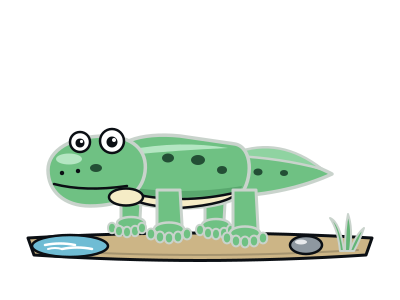
- Four-limbed animalsFish that walked: every frog, lizard, bird and mammal inherits their four limbs.
- TiktaalikA 'fishapod' with a neck, wrists and lungs, found in Arctic rocks where scientists predicted.
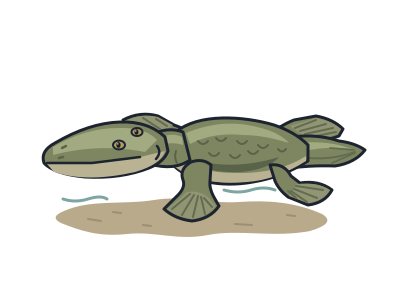
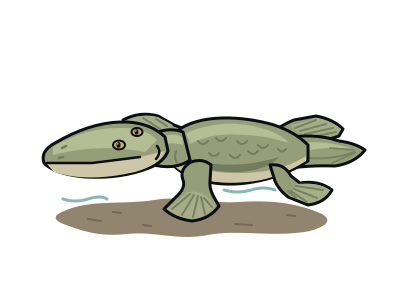
- AcanthostegaHad real legs with eight fingers, yet still lived in water and had gills.
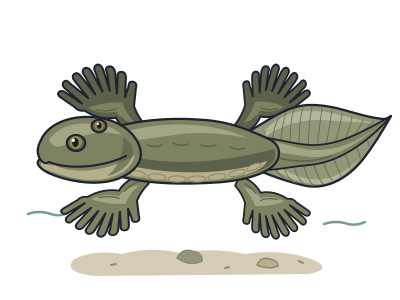
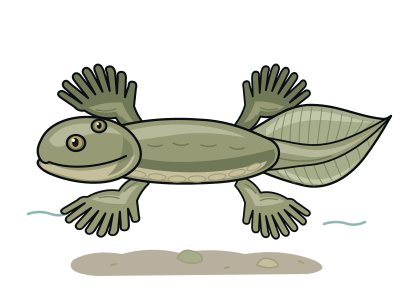
- IchthyostegaA seven-toed, seal-like animal that may have hauled itself across Devonian mudflats.
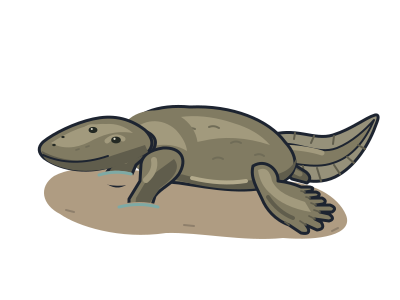
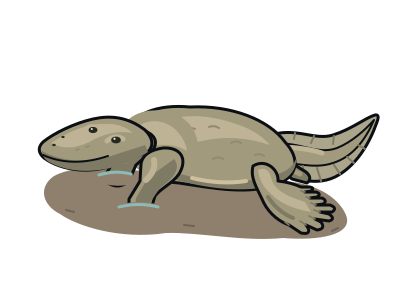
- PanderichthysA flat-headed, crocodile-like fish whose fins hide tiny finger-like bones.
- ElpistostegeA complete fossil fish from Canada with rows of finger bones inside its fin.
- GogonasusAn Australian fossil fish so perfectly preserved in 3D that you can see the arm bones in its fins.