A species
Cold-water coral
Desmophyllum pertusum
A reef-building coral that lives in cold, deep water where almost no sunlight reaches.
You and the cold-water coral meet in the Animals branch, shown at about 700 million years ago (on 1 November, in a calendar from life's shared ancestor to today).
Most people picture coral reefs in warm, sunny, shallow seas. This coral builds reefs somewhere very different: in cold, dark water, usually about 200 to 1,000 metres down, where too little sunlight reaches for plants or algae to grow. It is a stony coral, like the staghorn and brain corals beside it on the tree. But it has no algae living inside it, and it does not need sunlight at all.
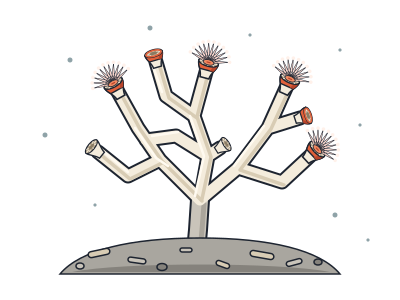
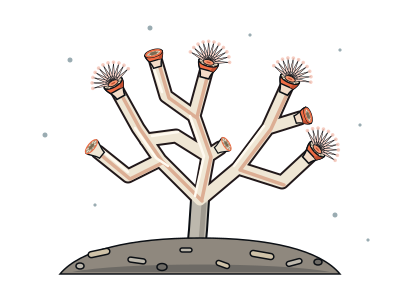
Each coral is a colony of tiny animals called polyps. Every polyp sits in a stony cup about the size of a fingernail. It reaches out stinging tentacles to catch plankton, krill and other small creatures carried in by strong currents.
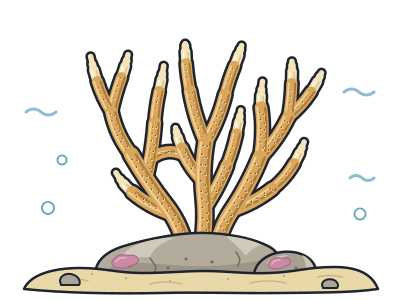
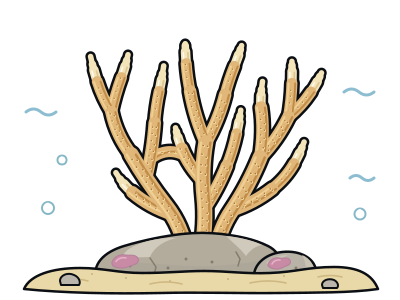
The colonies grow as bushy, branching thickets whose branches join together. Over thousands of years they build reef mounds. Only a thin layer on top is living coral. Underneath is old dead skeleton, sand and mud. Whole reefs often rise only a few millimetres a year, or less. Yet one reef off Norway is about 35 kilometres long. Off the south-eastern United States, scientists have mapped a huge field of tens of thousands of mounds, much of it built mainly by this coral.
About 1,300 other kinds of living things have been found on these reefs, including sponges, other corals and shellfish. Fishing nets dragged along the seabed are estimated to have damaged about a third to a half of the reef area off Norway.
At home on oil rigs
Colonies were found growing on 13 of 14 North Sea oil rigs that were checked.
Very old bushes
A single coral bush may be up to about 1,000 years old.
Picky eaters
Polyps can swallow food up to about 2 cm across and can tell food from mud using chemical signals.