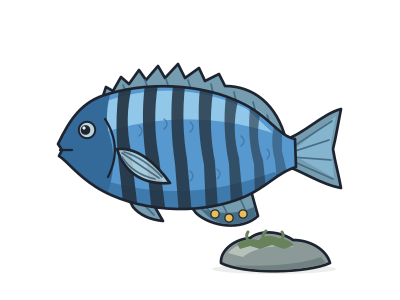
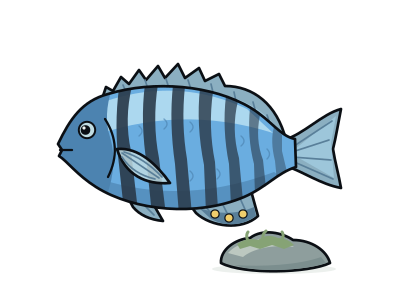
A species
Zebra mbuna
Maylandia zebra
One lake, hundreds of fish relatives
You and the zebra mbuna meet in the Bony fish and their descendants branch, shown at about 430 million years ago (on 24 November, in a calendar from life's shared ancestor to today).
The zebra mbuna is one of hundreds of cichlid fish species that evolved in a single African lake. That burst of evolution was brief on Earth's long timescale. These Lake Malawi relatives have taken up very different ways of life. Some hunt fish in open water; others eat tiny drifting animals. Despite these differences, their DNA is remarkably similar.
This member of the family lives among rocks in Lake Malawi, a freshwater lake in south-eastern Africa. It is native nowhere else. To feed, it points its body roughly at right angles to a rock and combs loose food from the living coating. It also eats tiny organisms drifting through open water, so rocks do not supply every meal.
A female's mouth doubles as a nursery. She protects her eggs and developing young inside it for about three weeks. Eggs held this way are being cared for, not simply eaten.
Fish with a voice
Zebra mbuna make short series of low-pitched sound pulses during courtship and disputes over territory. Larger males generally make lower-pitched sounds.
Moving sand by mouth
Males carry sand away from a shelter and deposit it towards the edges of their territory.
A social pecking order
These fish live in groups with a social ranking. Males defend territories among the rocks.
Next to it on the tree
- Freshwater angelfishA tall, striped Amazon fish whose parents guard their eggs on a leaf.
- Nile tilapiaEaten since ancient Egypt and now one of the most farmed fish on Earth; mothers carry young in their mouth.
- DiscusParents feed their babies with a nourishing coat of slime on their skin, a kind of fish milk.