A species
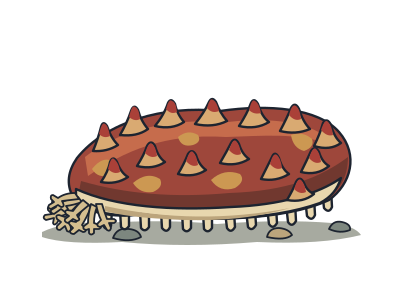
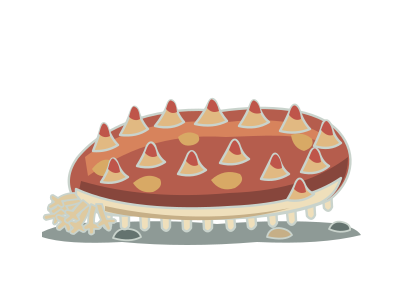
Giant California sea cucumber
Apostichopus californicus
A warty starfish relative with a remarkable escape trick.
You and the giant california sea cucumber meet in the Starfish, sea squirts and us branch, shown at about 560 million years ago (on 13 November, in a calendar from life's shared ancestor to today).
This warty, sausage-shaped animal is a relative of starfish, sea urchins and sand dollars. Like them, it has no backbone. Its most startling escape trick is to push out some internal organs when threatened. This can put a predator off, and the sea cucumber can regrow the organs it has lost.
Despite its soft look, it has a skeleton: tiny hard pieces hidden in its body wall, rather than a large, rigid shell. Its shape is not fixed, either. By adjusting its muscles and how flexible its skin is, it can change from short and firm to long and floppy.
It lives along western North America, from Alaska to Baja California in Mexico. Its home is the seabed, including gravel, broken shells and rock. As it feeds, it stirs the surface and returns nutrients that microscopic algae can use.
Breathing through its rear
It draws seawater in through its rear opening. Two branching structures inside its body take oxygen from the water.
A travelling guest
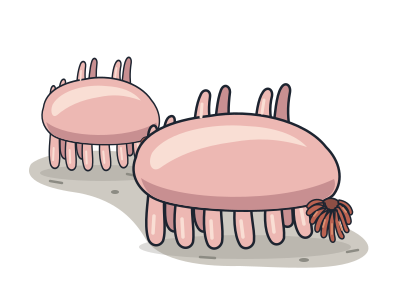
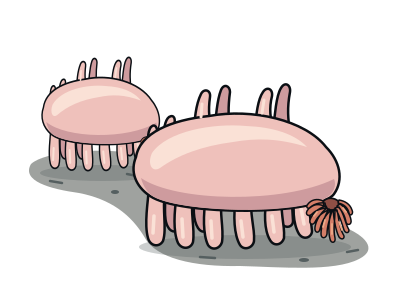
A small scale worm sometimes lives on the outside of its body.
Young on the move
Adults release eggs or sperm into seawater. Their young drift in the water before settling on the seabed.