A species
Quokka
Setonix brachyurus
A cat-sized wallaby that always seems to be smiling
You and the quokka meet in the Live-bearing mammals branch, shown at about 160 million years ago (on 18 December, in a calendar from life's shared ancestor to today).
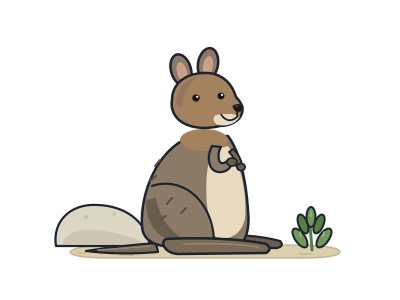
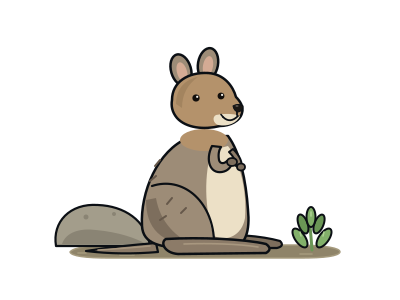
Meet a wallaby about the size of a house cat. The corners of its mouth curve upwards, so it looks as if it is always smiling. That grin is just the shape of its face, though. It is not a sign that the animal is happy.
Small as it is, the quokka belongs to the kangaroo and wallaby family, along with the red kangaroo and even the tree-kangaroos. It is one of the smallest wallabies, and it has no close living relatives that share its own small branch of the family. Like its relatives, it is a marsupial. A mother has one joey at a time, and the joey lives in her pouch for about six months.
Quokkas are busiest at night and rest in the shade during the day. They eat grasses, leaves and other plants. Like cows, they bring swallowed food back up and chew it again. They can even climb a short way up trees.
Quokkas live only in the south-west of Western Australia. Most of them live on Rottnest and Bald Islands, which have no foxes. On the mainland, numbers fell sharply after foxes arrived, and the species is now listed as Vulnerable.
Mistaken for a giant rat
In 1696 the Dutch explorer Willem de Vlamingh called quokkas 'a kind of rat as big as a common cat'. He named their island 'rat nest', which became Rottnest Island.
A Noongar name
The word 'quokka' comes from the language of the Noongar, an Aboriginal people of south-western Australia. The original word was probably gwaga or gawaga.
Fire danger
In a 2015 bushfire near Northcliffe, about nine in every ten of a local group of roughly 500 quokkas are thought to have died.
Next to it on the tree
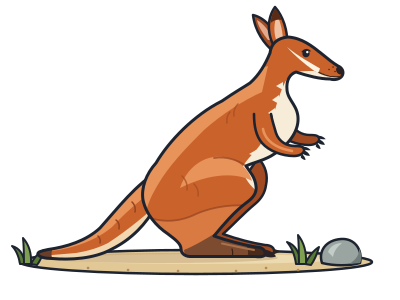
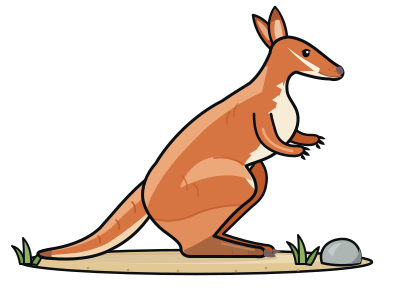
- Red kangarooHops at highway speeds using its tendons like springs, and can pause a pregnancy.
- Goodfellow’s tree-kangarooA kangaroo that went back up into the trees, with strong arms and a long balancing tail.
- Giant short-faced kangarooAn Ice Age kangaroo about two metres tall that probably walked upright instead of hopping.