A species
Pygmy seahorse
Hippocampus bargibanti
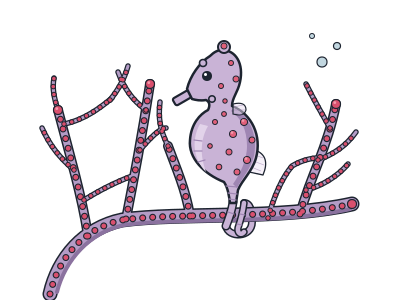
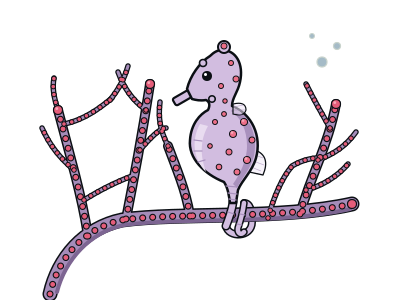
A seahorse smaller than your fingernail, hiding in plain sight on a sea fan.
You and the pygmy seahorse meet in the Bony fish and their descendants branch, shown at about 430 million years ago (on 24 November, in a calendar from life's shared ancestor to today).
This seahorse is about the size of your fingernail, and it blends into its sea fan so well that nobody spotted it in the sea. In 1969 a scientist in New Caledonia collected a sea fan. Only when the fan was on the lab table did he notice tiny seahorses clinging to its branches. The species was named in 1970. It was the first pygmy seahorse ever described.
It is not a baby. It is a fully grown seahorse that usually reaches only about 2 centimetres long. It is a relative of much bigger seahorses, such as the lined seahorse, and of the leafy seadragon. Like other seahorses, the father carries the eggs in a pouch and gives birth to live young.
Its disguise is remarkable. Its body matches the colour of the fan's stems, and round bumps on its skin copy the fan's tiny polyps. Some are pale grey or purple with pink or red bumps. Others are yellow with orange bumps.
Newborns do not start out matching. They drift in open water for a week or two. Then, over about five days after settling on a fan, they change to match its colour and texture. Adults usually stay on one fan, holding on with their curled tails.
Crowded fans
As many as 28 pairs have been found living on a single sea fan.
A missing gene
A study of its genes found that losing one gene stops its snout from growing long, so adults keep a short, baby-like face.
Tiny immune toolkit
It has the smallest known set of immune-system genes of any animal with a backbone. Researchers suggest its sea fan home may help protect it from germs.