A species
Prometheoarchaeum
Prometheoarchaeum syntrophicum
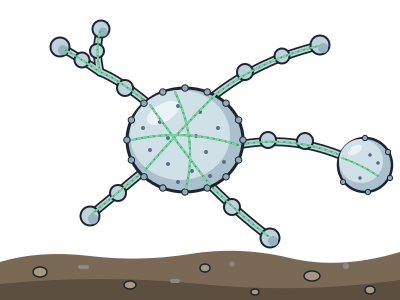
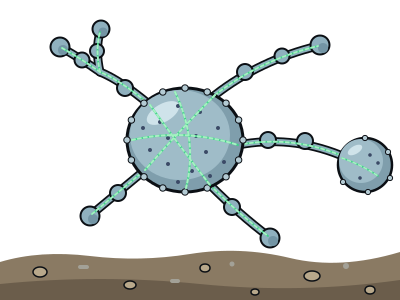
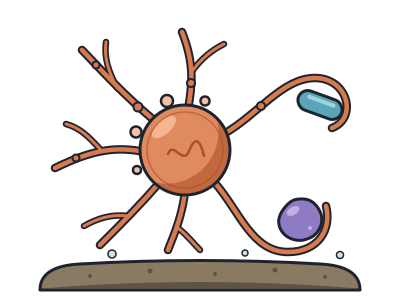
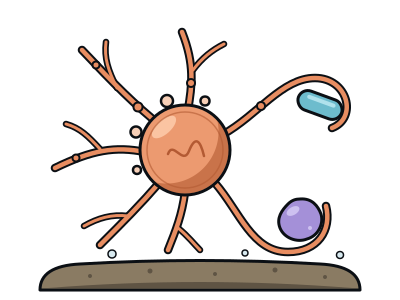
The first Asgard archaeon ever grown in a lab: a tiny ball with long tentacles, and it took 12 years of patience to grow.
You and the prometheoarchaeum meet in the Asgard archaea branch, shown at about 2.8 billion years ago (on 2 May, in a calendar from life's shared ancestor to today).
This tiny microbe is the first Asgard archaeon anyone has managed to grow in a lab, and getting it to grow took about 12 years. Asgard archaea are the group of simple single cells most closely related to complex cells, the kind that make up animals, plants, fungi and you. That makes this mud-dweller a surprising relative of ours.
In 2006, scientists collected mud from a cold methane seep about 2,500 metres deep off the coast of Japan. They rebuilt that chilly seabed in a tank packed with foam sponges, fed it methane and artificial seawater, and waited. The microbe first showed up in 2012, and the team's main paper finally came out in a science journal in 2020.
Each cell is a little ball about half a thousandth of a millimetre across. As it grows, it sprouts long, branching tentacles. It cannot live alone. It breaks down the building blocks of proteins and gives off hydrogen, which partner microbes eat. Researchers suggest its tentacles may wrap around these partners like a hug.
Even though it carries many genes that look like those of complex cells, it has no nucleus and no other compartments inside.
Named after a Titan
Its name honours Prometheus, the Titan who, in some Greek myths, made humans out of clay.
In no hurry
A cell takes about 2 to 3 weeks to split in two. In ideal conditions, the gut bacterium E. coli can do it in about 20 minutes.
Not just bacteria
One of its lab partners was a bacterium. The other was a methane-making archaeon. So both kinds of simple cell could use the hydrogen it gave off.