A species
Loki's archaeon
Candidatus Lokiarchaeum ossiferum
A speck from seaside mud with a tiny skeleton made of a cousin of your muscle protein.
You and the loki's archaeon meet in the Asgard archaea branch, shown at about 2.8 billion years ago (on 2 May, in a calendar from life's shared ancestor to today).
Your muscles move because a protein called actin is pulled along by other proteins. In 2022, scientists found a close relative of actin making a skeleton inside a tiny microbe from coastal mud. This microbe belongs to the Asgard archaea. They are the closest known simple-celled relatives of the complex cells that make up animals, plants and fungi.
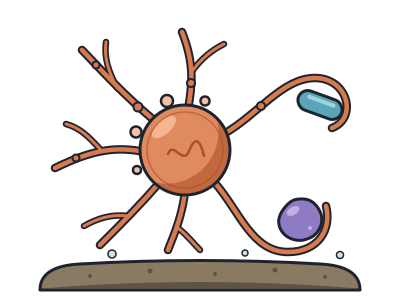
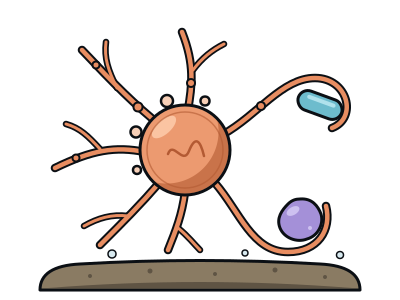
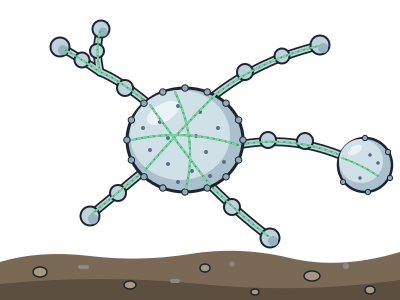
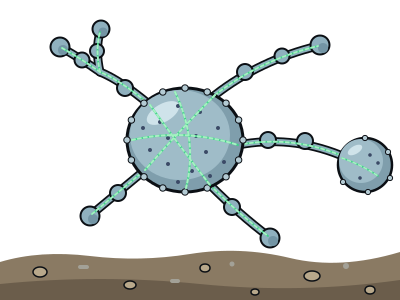
Its round body is only about 0.3 to 1 micrometre across. That is about a hundred times narrower than a human hair, or more. Thin, branching, tentacle-like arms grow out from the body, and they sometimes seem to link one cell to the next. A network of filaments made of its own actin-like protein runs through the body and into the arms. Scientists used to think such a large actin network was found only in complex cells. Yet this microbe has no nucleus.
The mud came from a small canal near Piran, in Slovenia, that regularly gets seawater. It took a team in Vienna about six years to get the microbe growing well. In the published cultures it only grows alongside partner microbes. It was the second Asgard archaeon ever grown in a lab, after its relative Prometheoarchaeum.
A name that means skeleton
Its species name, ossiferum, is Latin for 'skeleton-carrying'. It refers to the protein scaffold inside the cell, not to real bones.
Slow and steady
In the lab it takes about one to two weeks for its numbers to double. It grows at about 20 °C, with no oxygen, feeding on carbon-based food.
A bigger instruction book
Its DNA is about 6 million letters long. That is about 1.6 million more letters than its relative Prometheoarchaeum has.