A species
American paddlefish
Polyodon spathula
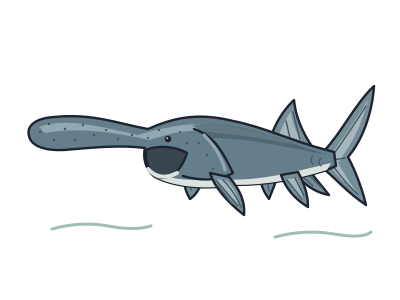
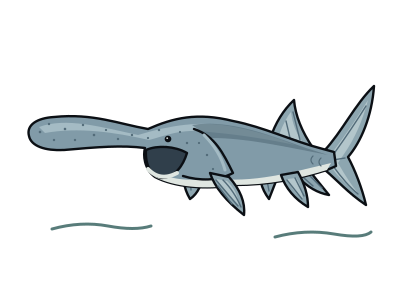
A paddle-shaped snout that senses tiny animals’ electricity.
You and the american paddlefish meet in the Bony fish and their descendants branch, shown at about 430 million years ago (on 24 November, in a calendar from life's shared ancestor to today).
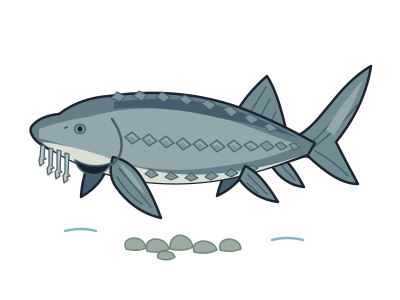
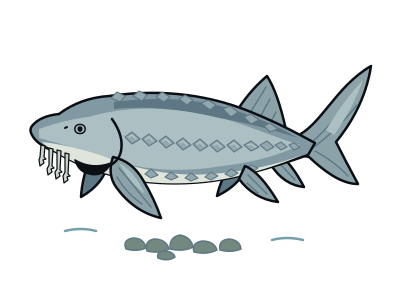
The American paddlefish’s long, flat snout works like an antenna. Sensors detect weak electric fields made by tiny animals drifting in the water. These animals are part of the plankton. Young paddlefish can use this sense to catch food even in darkness. The beluga sturgeon on the neighbouring branch is a relative, but not another kind of paddlefish.
Its feeding style changes as it grows. Larger paddlefish swim with their enormous mouths open. Closely packed structures on their gills strain tiny animals from the passing water, including small relatives of crabs and the young of insects. Detecting electricity does not mean delivering electric shocks: this fish senses fields made by other animals.
Despite its sharklike outline, it belongs among the ray-finned bony fishes. Yet its skeleton is mainly cartilage, the flexible material in the tip of your nose. Its native home is the Mississippi Valley’s large river systems and neighbouring rivers that drain towards the Gulf of Mexico.
A toothless mouth
Adult paddlefish have no teeth.
The last paddlefish species
It is the only surviving paddlefish species. The Chinese paddlefish was officially declared extinct in 2022.
A sizeable paddle
The snout can make up about a third of the fish’s total length.