A species
Giant oarfish
Regalecus glesne
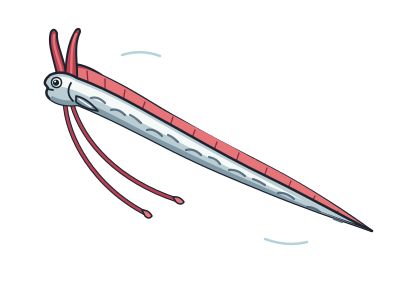
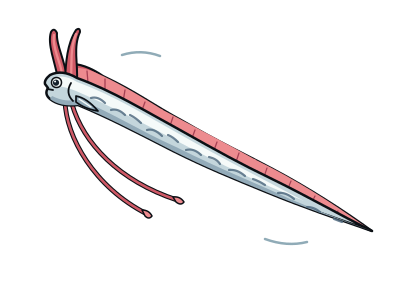
A silver ribbon with a sea-serpent silhouette.
You and the giant oarfish meet in the Bony fish and their descendants branch, shown at about 430 million years ago (on 24 November, in a calendar from life's shared ancestor to today).
The longest bony fish alive is a silver ribbon that can reach about 8 metres—roughly the length of a small bus. The giant oarfish looks like a sea serpent, but it belongs to the same broad fish branch as eels, herrings, salmon and cod. It is neither a snake nor an eel.
A crimson fin runs along its back, rising into a crest above the head. Its body is flattened from side to side, with dark streaks and blotches against the silver. To swim, it can send waves along its long back fin while keeping its body fairly straight.
This fish lives in the open ocean around the world, swimming in the water rather than resting on the seabed. Despite its enormous size, it eats tiny animals called krill, which look like small shrimps. Structures along its gills help strain small prey from the water.
No built-in gas bag
It has no swim bladder, the internal gas-filled organ that helps many other fish stay afloat.
Silver without scales
Its silver appearance comes from guanine covering its skin, rather than ordinary overlapping scales.
A mouth that reaches forwards
Its small mouth can project forwards, changing the outline of its blunt head.