An extinct species
Mawsonia †
Mawsonia gigas
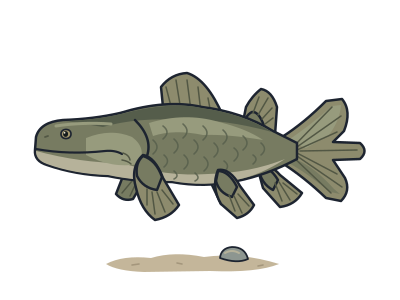
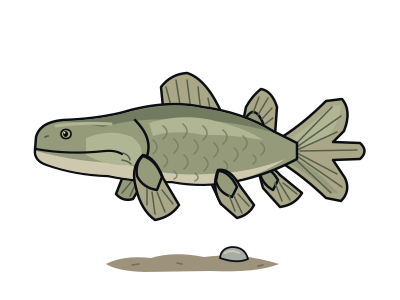
A car-sized coelacanth from dinosaur-age rivers
Lived about 150–94 million years ago.
You and the mawsonia meet in the Lobe-finned fish branch, shown at about 410 million years ago (on 26 November, in a calendar from life's shared ancestor to today).
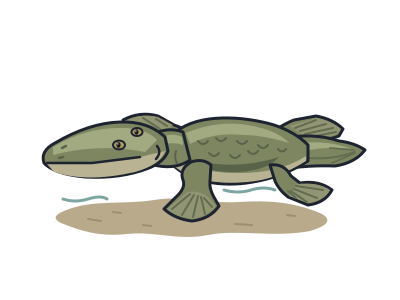
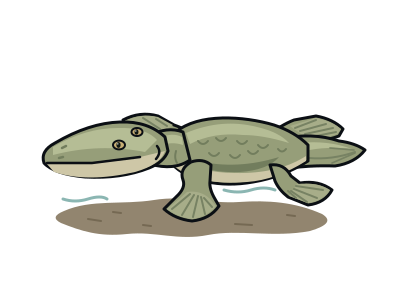
A giant relative of living coelacanths swam through dinosaur-age rivers. Large individuals could reach about 5 metres, as long as a large car. Fossils assigned to this fish dated from about 150 to 94 million years ago. They came from Brazil, Uruguay and Africa. It mainly inhabited fresh water, but could also tolerate coastal waters where fresh and salt water mixed.
It belonged to a different family from living coelacanths, within the same wider group. It was a lobe-finned fish: its fleshy fins on either side of the body contained supporting bones. That wider lobe-finned family tree also included the branch that produced land animals with backbones, including us. This fish was a relative of that branch, not a direct human ancestor.
The car-sized reconstruction was an estimate, not a measurement of a complete giant skeleton. The largest length estimate came from a fragment of a skull bone that supported the jaw. Other Brazilian fossils preserved much of the body skeleton, helping researchers piece together its appearance.
A much smaller youngster
One Brazilian specimen was estimated at about 32 centimetres long and interpreted as a young fish.
Hollow fin rods
Some broken bony rods that supported the fins had hollow interiors.
Bony lung plates
One body fossil preserved ribs and bony plates associated with a lung.
Next to it on the tree
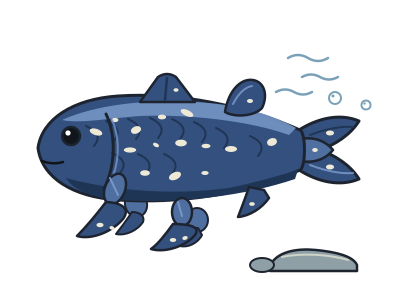
- CoelacanthThought extinct for 66 million years until one turned up in a fishing net in 1938.
- LungfishOur closest living fish relatives: they breathe air and some can survive years dried in mud.
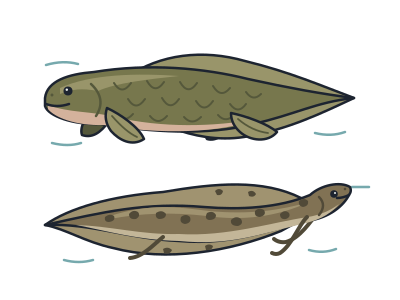
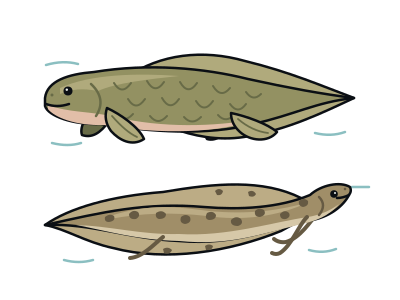
- DipterusA Devonian lungfish from Scotland, already crushing shells with tooth plates like today's lungfish.
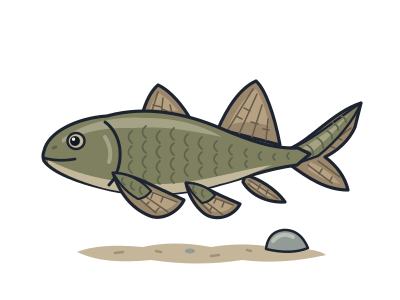
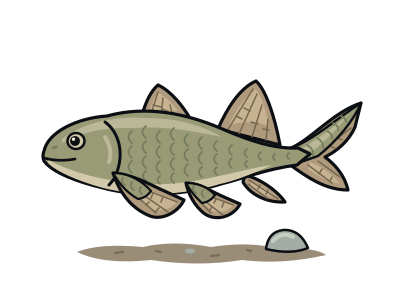
- Fish on the way to landFish that grew wrists, necks and lungs, step by step, until some walked out of the water.
- Indonesian coelacanthA second living coelacanth, recognised in 1997 when a biologist on honeymoon spotted one in a Sulawesi market.
- RebellatrixA fork-tailed coelacanth built for speed, unlike its slow cousins, from just after the great Permian die-off.