A species
Red lionfish
Pterois volitans
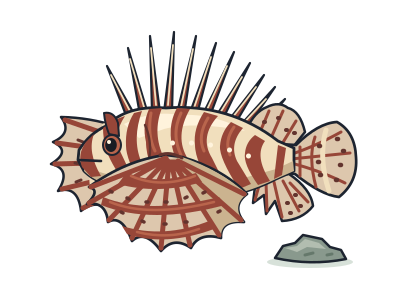
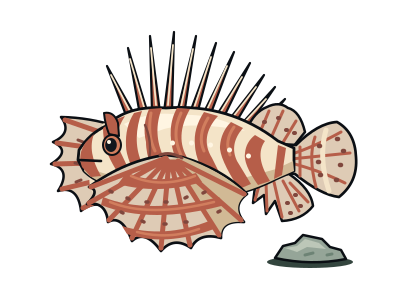
Striped fans, venomous spines and an outsized impact on Atlantic reefs.
You and the red lionfish meet in the Bony fish and their descendants branch, shown at about 430 million years ago (on 24 November, in a calendar from life's shared ancestor to today).
Striped fans and venomous spines make the red lionfish a striking Atlantic invader. It belongs to the scorpionfish family. Like the seahorses and tuna nearby on the tree, it also belongs to the much wider spiny-finned fish group. Its natural home is the Indo-Pacific, including Australia: it is not an invader everywhere it lives.
Its broad side fins spread like fans to corner small fish, shrimps and crabs. Then a quick movement of its jaws catches and swallows its prey whole. Those showy side fins are not venomous. The venom-bearing spines sit along its back and on smaller fins underneath. They provide defence, not a way to catch dinner.
Introduced lionfish now live across the western Atlantic, Caribbean and Gulf of Mexico. They eat some of the same prey as native snappers and groupers, potentially competing for food. They also eat fish that graze on algae. With fewer grazers, algae can grow more freely and harm corals. The invasion involves both red lionfish and a very similar relative, the devil firefish.
Eyebrow-like extras
A fleshy projection usually grows above each eye. These are often long in young fish and more leaf-shaped in adults.
Floating eggs
Females release their eggs in floating, mucus-covered masses near the water’s surface.
Daytime hideaways
During daylight, red lionfish often shelter beneath ledges or inside caves and cracks.
Next to it on the tree
- European perchA green-striped lake fish with a spiky back fin, the fish that gave the whole perch family its name.
- Atlantic goliath grouperCan outweigh three people and booms loudly with its swim bladder; recovering after a fishing ban.
- Reef stonefishLooks exactly like a lumpy rock and carries the strongest venom of any fish, purely for defence.
- Blackfin icefishAn Antarctic fish with clear, colourless blood: it has no red blood cells at all.