A species
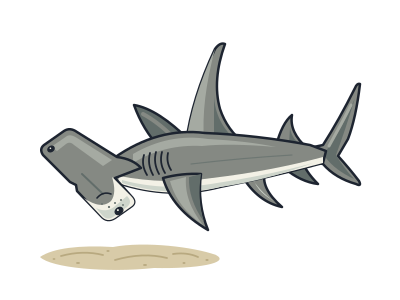
Great hammerhead
Sphyrna mokarran
A wide sensor bar for finding hidden stingrays
You and the great hammerhead meet in the Jawed vertebrates branch, shown at about 465 million years ago (on 21 November, in a calendar from life's shared ancestor to today).
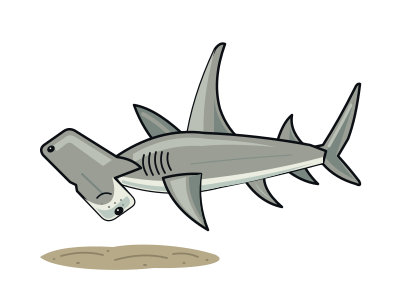
The great hammerhead’s hammer-shaped head works like a wide sensor bar, helping it find stingrays hidden in sand. Tiny, jelly-filled sensing organs beneath the head pick up weak electrical signals from prey. The broad head spreads these sensors over a wide area. Stingrays are relatives as well as food: they belong to the same major group as sharks. Other sharks and rays share this electrical sense.
This is the largest kind of hammerhead. Its eyes sit at the outer ends of its head. It does not eat only rays. Its food also includes other fishes and squid.
Great hammerheads live in warm seas around the world, both near coasts and offshore. In Australia, their range stretches from Mandurah in Western Australia, around the tropical north, to about Sydney.
A changing head
Young great hammerheads have a more curved front edge to their head. In adults, it is almost straight, with a shallow notch in the middle.
Born live
Females give birth to live young rather than laying egg cases.
In serious trouble
The species is classed as Critically Endangered. Fishing threats include capture for its valuable fins and accidental capture while other animals are being caught.
Next to it on the tree
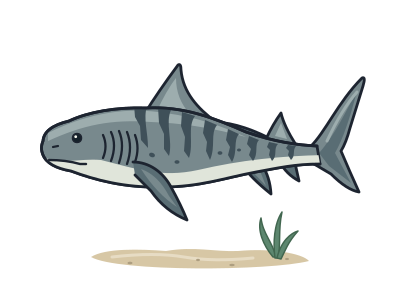
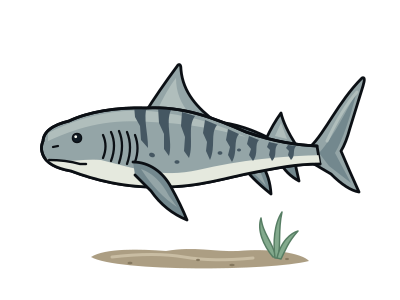
- Tiger sharkA striped ocean wanderer that eats almost anything, from sea turtles to licence plates.
- Bull sharkA sea shark that swims thousands of kilometres up rivers like the Amazon and Mississippi.
- Blue sharkA slender, indigo ocean wanderer that rides currents right around the Atlantic.
- Blacktip reef sharkPatrols shallow coral lagoons with its black-tipped fin often poking above the surface.
- Small-spotted catsharkIts empty egg cases wash up on beaches as the leathery "mermaid's purses".