A species
Northern glass frog
Hyalinobatrachium fleischmanni
A tiny frog with a see-through belly, and a father who guards the eggs
You and the northern glass frog meet in the Four-limbed animals branch, shown at about 350 million years ago (on 1 December, in a calendar from life's shared ancestor to today).
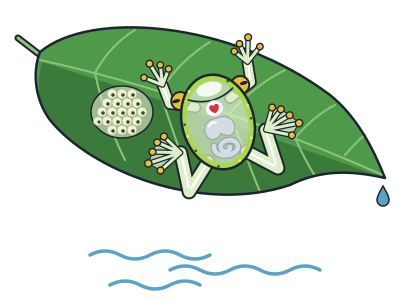
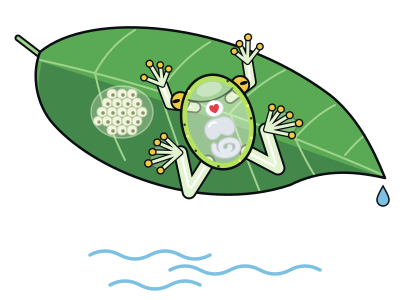
Look at this little green frog from underneath and you can see straight through its belly. Its small red heart can often be seen beating. You can also see white bones and a shiny silver-white covering over its liver and gut. It looks a lot like a tree frog, but it belongs to a separate family, the glass frogs. On this tree it sits with its relatives the toads, tree frogs and poison frogs.
It is tiny, about 2 to 3 cm long, which is roughly the length of a paperclip. Its back is lime green with tiny dark speckles and yellow spots, and its eyes are gold. By day it sleeps upside down under a leaf. While it sleeps, it takes nearly 90% of the red blood cells out of its bloodstream and packs them into its liver. That makes it about two to three times more see-through.
In the rainy season, a female lays a small cluster of eggs under a leaf hanging over a stream, then leaves. The father stays. He sits on the eggs for weeks, a bit like a hen, and wets them with water from his bladder so they do not dry out. When the eggs hatch, the tadpoles drop into the stream below.
A one-note song
Males call with a single short, high-pitched 'peep', often while hanging upside down under a leaf.
Slow-growing tadpoles
The tadpoles hide in leaf litter or gravel on the stream bed. They may take 1 to 2 years to turn into frogs.
Blood that comes back
When the frog wakes up at night, the hidden red blood cells flow back into its body. Even though they were tightly packed in the liver, they do not form dangerous clots.
Next to it on the tree
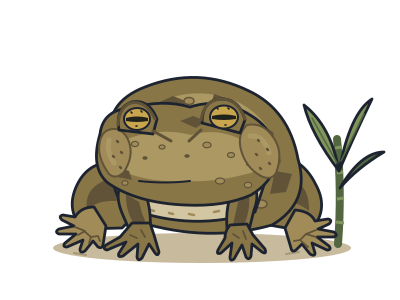
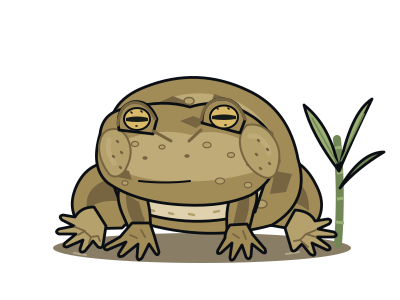
- Cane toadBrought to Australia to eat beetles, it spread across the continent instead.
- Tree frogsSticky toe pads and long legs let these frogs live high in trees, far from any pond.
- Poison dart frogsJewel-bright frogs whose colours warn that their skin is laced with toxins from their food.
- Amazonian horned frogA wide-mouthed ambusher with horn-like eyelids, nicknamed the Pac-Man frog.
- Darwin's frogThe father raises the tadpoles inside his vocal sac, then coughs up tiny froglets.