A species
Frilled shark
Chlamydoselachus anguineus
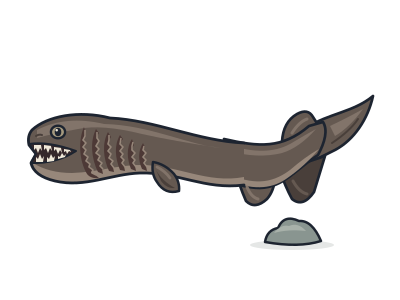
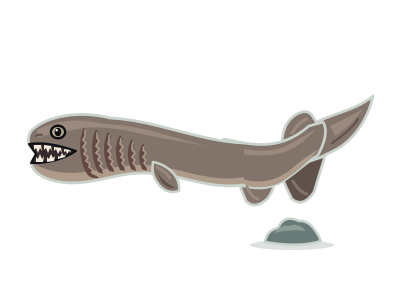
An eel-like shark with frilly gills and about 300 tiny, fork-shaped teeth.
You and the frilled shark meet in the Jawed vertebrates branch, shown at about 465 million years ago (on 21 November, in a calendar from life's shared ancestor to today).
With an eel-like body and about 300 teeth shaped like tiny three-pronged forks, this deep-sea animal may not look like a familiar shark. But it belongs to the same shark family tree as great whites and hammerheads. Each tooth has three long points, with two much smaller points tucked between them.
Its name comes from the frilly edges around its gill openings. There are six openings on each side, and the first pair meets beneath its throat. These frills are part of the gill region, not a separate collar. Its long body is dark brown, grey-brown or almost black.
It is most often reported about 500 to 1,000 metres below the surface. It lives around the underwater edges of continents and islands, near the seabed or swimming above it. Records come from widely separated parts of several oceans, including waters around Australia.
Replacement teeth
Teeth at the edge of the jaw are gradually replaced by teeth growing behind them.
Another frilled shark
There are two living frilled-shark species. The other was described in 2009 from waters off southern Africa.
Accidental catches
Deep-water fisheries sometimes catch frilled sharks accidentally in trawls and deep-set nets.
Next to it on the tree
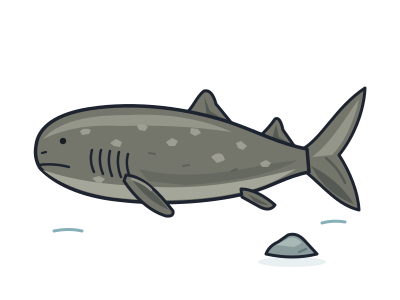
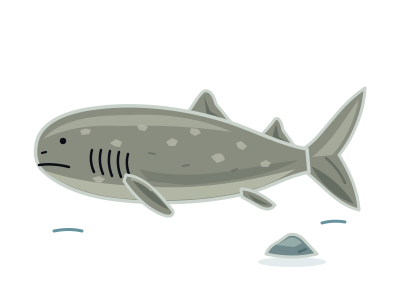
- Greenland sharkA slow Arctic giant that may live 270 years or more, the longest-lived vertebrate known.
- Spiny dogfishA small shark with one of the longest pregnancies of any animal: about two years.
- AngelsharkA flat shark that looks like a ray; once common in Europe, now mostly found around the Canary Islands.
- Longnose sawsharkHas a toothed saw for a snout with two long whiskers, like a sawfish but a true shark.
- Dwarf lanternsharkThe smallest shark known, about the length of a pencil, with a glowing belly.