A species
Siamese fighting fish
Betta splendens
Flowing fins, surface breaths and a nest made of bubbles.
You and the siamese fighting fish meet in the Bony fish and their descendants branch, shown at about 430 million years ago (on 24 November, in a calendar from life's shared ancestor to today).
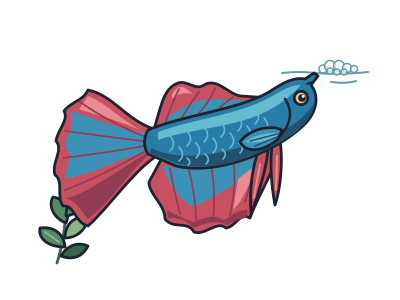
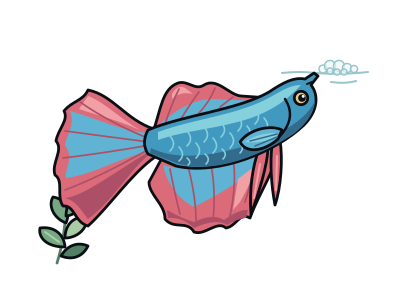
Best known as a flowing-finned pet, the Siamese fighting fish belongs to the gourami family. It has two surprising habits: it breathes air and builds bubble nests. A special breathing structure called the labyrinth organ lets it use air gulped at the surface. This helps it live in water with little oxygen.
The male makes a floating nest by taking air into his mouth and releasing bubbles coated in mucus. He guards the eggs and keeps them in the nest. After hatching, the young stay there for several days. This floating patch of bubbles is a nursery, not a way to add oxygen to the whole pond.
The spectacular fins and brilliant colours of ornamental fish were developed by people choosing which fish to breed. Wild fish have much shorter fins and are usually subdued green, brown or grey. In their native Thailand, they live among thick freshwater plants in places such as marshes, rice paddies and slow-moving streams.
Small prey
Their natural food includes mosquito larvae, other young insects and tiny drifting animals.
Count seven fins
A typical single-tailed fish has seven fins: a tail fin, a back fin, a long underside fin and two pairs of smaller fins.
An Australian newcomer
Introduced populations live in Northern Territory wetlands, including the Adelaide River floodplain. They are not native Australian fish.