An extinct species
Devil frog †
Beelzebufo ampinga
A giant frog with a beach-ball-sized reputation.
Lived about 70–66 million years ago.
You and the devil frog meet in the Four-limbed animals branch, shown at about 350 million years ago (on 1 December, in a calendar from life's shared ancestor to today).
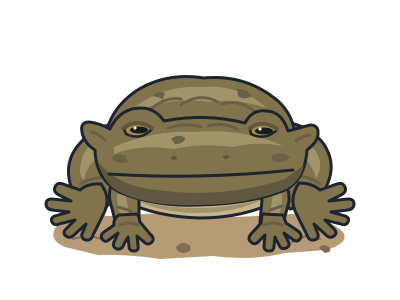
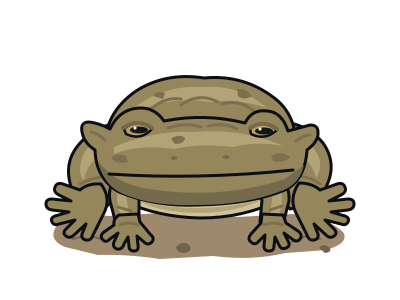
The devil frog's beach-ball-sized reputation came from an early estimate that later fossil discoveries cut down. It was a frog, not a dinosaur, and living frogs were its relatives. Revised reconstructions suggested a body about 19–23 centimetres long, without the legs: shorter than a 30-centimetre ruler, but still a large frog.
It lived in what is now northwestern Madagascar about 70 to 66 million years ago. Fossils showed a wide skull with unusually thick, strong bones. Reconstructions gave it a squat body, sturdy limbs and a huge mouth. These whole-body pictures were built from incomplete remains, rather than one complete fossil animal.
Researchers reconstructed its home as a landscape with long dry spells interrupted by heavy rain. Its broad mouth and sturdy skull offered clues about feeding, but did not reveal its actual meals. No preserved meal showed that it swallowed a baby dinosaur.
Named in 2008
Researchers formally named the devil frog in 2008.
Many scattered pieces
A 2014 study recorded 64 fossil specimens from 27 sites, mostly incomplete skull bones.
A useful discovery
A partial skull found with several backbone bones in 2010–2011 helped researchers check how scattered pieces fitted together.
Next to it on the tree
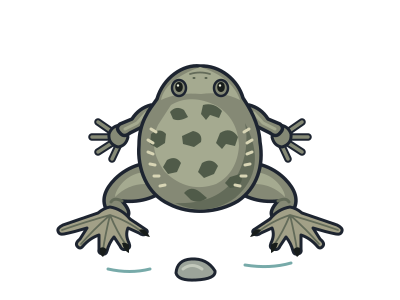
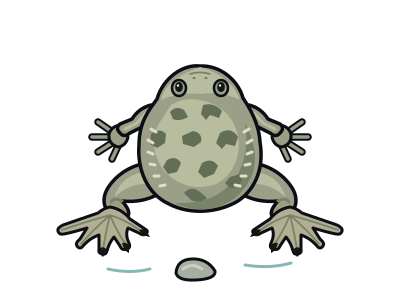
- African clawed frogA tongueless frog once used as a pregnancy test, and a key animal in biology labs.
- Toads, tree frogs and poison frogsHalf of all frog species, mostly from the Americas, burst into variety as the dinosaurs vanished.
- True frogs and kinThe classic pond frogs, now found almost worldwide, from tiny leaf frogs to giant goliaths and gliding flying frogs.
- Coastal tailed frogLives in icy mountain streams; the male's 'tail' helps it mate without being swept away.
- Common midwife toadThe father carries strings of eggs wrapped around his back legs until they are ready to hatch.