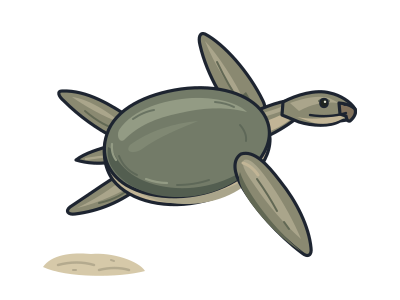
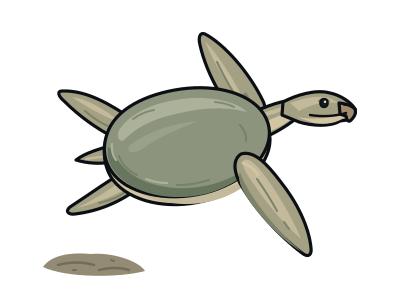
An extinct species
Archelon †
Archelon ischyros
A sea turtle as long as a small car
Lived about 81–74 million years ago.
You and the archelon meet in the Amniotes branch, shown at about 320 million years ago (on 4 December, in a calendar from life's shared ancestor to today).
As long as a small car, Archelon was a relative of today’s sea turtles and tortoises—not a dinosaur. It lived about 81 to 74 million years ago, while dinosaurs roamed the land. The largest known specimen measured about 4.6 metres from head to tail.
It swam in a shallow sea that stretched across central North America, linking the Arctic Ocean with the Gulf of Mexico. Places now far inland were once beneath this water. Its huge front flippers provided swimming power, working rather like wings moving through water.
Fossil bones showed that its back had an open framework rather than the continuous bony armour of most familiar turtles. Scientists reconstructed a tough, leathery covering over that framework; the gaps did not mean holes through its living back. Its skull also preserved evidence of a strongly hooked beak and massive jaws.
Named in 1896
George Wieland first scientifically described it in 1896, using fossils from South Dakota.
A smaller relative
Protostega belonged to the same extinct turtle family but was smaller. Its fossils were also found in Manitoba, Canada.
Bones found apart
One North Dakota find included part of a lower jaw and a partial skeleton whose bones had mostly separated before discovery.
Next to it on the tree
- Green sea turtleNavigates by Earth's magnetic field to return to the beach where it hatched.
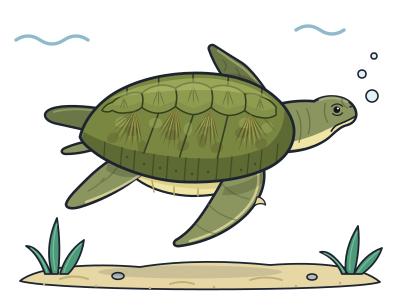
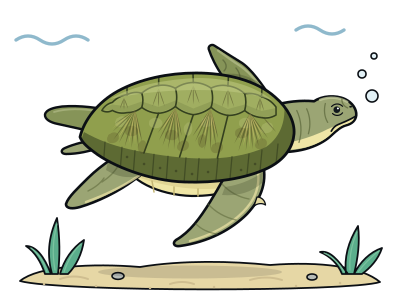
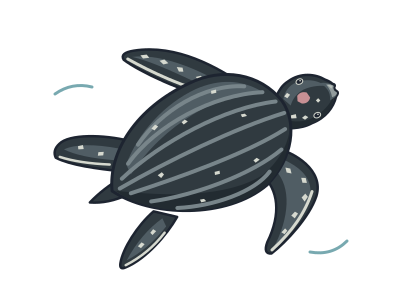
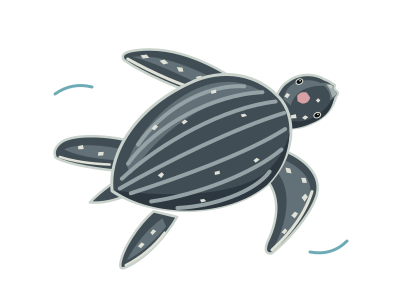
- Leatherback sea turtleThe largest living turtle has a soft, leathery shell and dives over a kilometre deep for jellyfish.
- Side-necked turtlesInstead of pulling their heads straight back, they tuck them sideways under the shell.
- TortoisesLand turtles with domed shells and elephant-like legs, from desert burrowers to island giants.
- Snapping turtlesBig-headed American river turtles with powerful jaws and long, rough tails.
- Eastern box turtleA hinged belly shell lets it close up completely, like a box with a lid.
- Red-eared sliderThe world's most common pet turtle, now living wild in ponds on every inhabited continent.