A species
Hot-vent bacterium
Aquifex aeolicus
A tiny microbe that lives in water close to boiling and feeds on hydrogen gas.
You and the hot-vent bacterium meet in the All life branch, shown at about 4.2 billion years ago (on 1 January, in a calendar from life's shared ancestor to today).
Picture water so hot it is nearly boiling. For this tiny bacterium, that is home. It grows in water at about 85 to 95 °C, which makes it one of the most heat-loving bacteria known. Its energy comes from hydrogen gas. It needs a little oxygen to use that hydrogen, but too much oxygen harms it.
It was first found at shallow volcanic vents in the sea at Vulcano, an island north of Sicily in Italy. Scientists once thought that only archaea, a separate group of single-celled microbes, could live in places like this. Finding a bacterium there was a surprise.
It makes its own food from carbon dioxide, much as plants do, but with no sunlight at all. When it joins hydrogen with oxygen for energy, the leftover is water. That is why its name means 'water-maker' in Latin.
Its genes are a patchwork. Some look like the genes of archaea. Others look most like those of the group that includes the stomach ulcer bacterium, which also appears on this tree. Swapping genes with other microbes long ago probably explains much of this mix.
A first for its genome
In 1998 it became the first heat-loving bacterium to have its whole genome read. Its genetic instructions are only about one-third the size of those of the common gut bacterium E. coli.
Help for clean energy
Its tough, heat-resistant enzymes for handling hydrogen are being studied for use in hydrogen fuel cells. One of its proteins forms tiny hollow cages that might one day carry medicines.
Whips and clumps
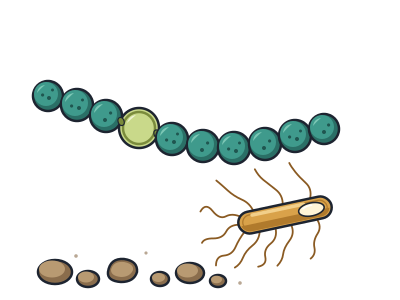
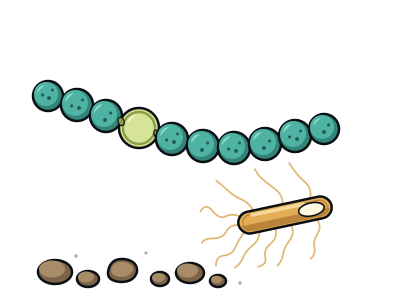
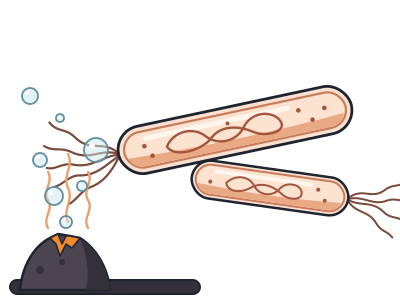
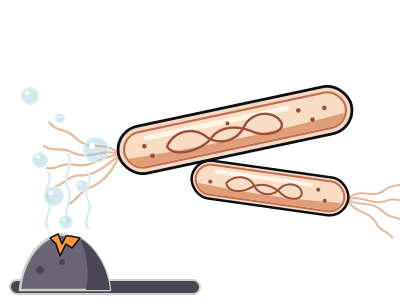
Each rod-shaped cell has a tuft of thin, whip-like flagella at one end. Cells can also stick together in clumps of up to about 100.