A species
Humpback anglerfish
Melanocetus johnsonii
A deep-sea fisher with her own glowing bait
You and the humpback anglerfish meet in the Bony fish and their descendants branch, shown at about 430 million years ago (on 24 November, in a calendar from life's shared ancestor to today).
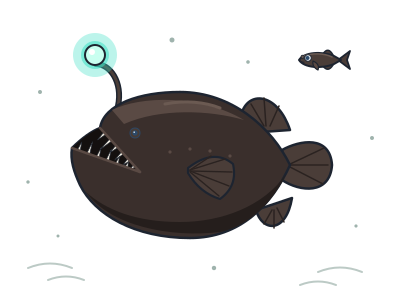
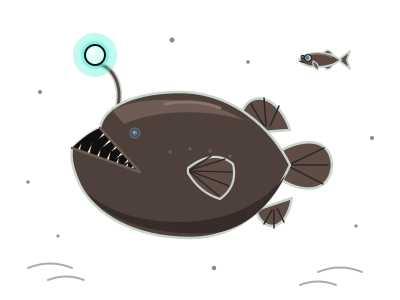
Far below the sunlit surface, where the water is almost black, the female humpback anglerfish goes fishing. A short 'rod' grows from her snout, with a glowing bulb at the tip. Small animals come towards the light, and her huge, upward-facing mouth full of sharp teeth snaps shut. Her stretchy belly can hold a very big meal.
The glow is not her own. It comes from bacteria living inside the bulb. This fish drifts in open water in warm and mild oceans around the world, usually about 100 to 1,500 metres down.
Males and females look very different. Females grow to about 18 centimetres at most, about the size of a large orange, and most are smaller. Males reach only about 3 centimetres and are slimmer. A male has no lure and no teeth in his jaws, just small pincer-like teeth at the front of his snout for gripping. You may have heard that the male fuses to the female for life. That happens in some other deep-sea anglerfish, but not in this one. Humpback males stay free-swimming and hold on to a female only for a short time.
Its relatives are a surprise. DNA studies place anglerfish close to pufferfish, triggerfish and ocean sunfish, which sit right beside it on the tree.
A lasting mark
A male's short grip can leave scars on the female's body.
Starts life near the top
Its eggs are thought to float in jelly-like rafts. The young live in the upper waters before moving down into the deep.
Borrowed light
The glowing bacteria in the lure have lost about half the genes of their free-living relatives, so they depend on the fish.
Next to it on the tree
- MonkfishA huge-mouthed bottom angler whose tail meat is sold as poor man's lobster.
- Warty frogfishWalks on hand-like fins and can swallow prey almost as big as itself in a split second.
- Red-lipped batfishA Galápagos fish with bright red lips that walks along the sea floor on its fins.
- Spotted handfishA rare Tasmanian fish that walks on hand-shaped fins instead of swimming.