A species
Taita African caecilian
Boulengerula taitana
A legless amphibian whose babies feed on their mother's outer skin.
You and the taita african caecilian meet in the Four-limbed animals branch, shown at about 350 million years ago (on 1 December, in a calendar from life's shared ancestor to today).
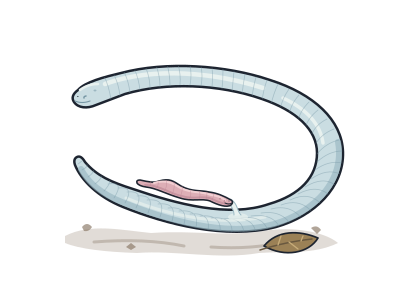
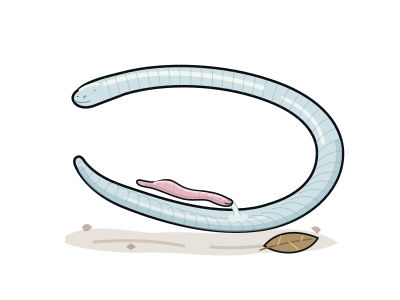
The Taita African caecilian is a legless, burrowing amphibian whose babies feed by peeling and eating the outer layer of their mother's skin. It looks like a worm, but it belongs to the amphibians, alongside frogs, toads, salamanders and newts.
The mother grows a fatty, nutrient-rich outer skin layer. Her babies use special teeth to remove it: they are eating that prepared layer, not their mother's whole body. Researchers have watched mothers caring for groups of two to nine babies, though that is not a fixed family size.
This hidden amphibian lives naturally only in the Taita Hills region of southeastern Kenya. Adults usually travel through underground burrows rather than over open ground. A local field guide puts their average length at about 28–30 centimetres, roughly as long as a school ruler.
A paler mother
Mothers caring for young look paler and milkier blue than other females.
Eggs joined by a strand
The eggs are connected by a string-like strand. Inside, developing babies can be seen curled around yellow yolk.
Changing colours
Young babies are pink. They become black and blue before they begin burrowing independently.