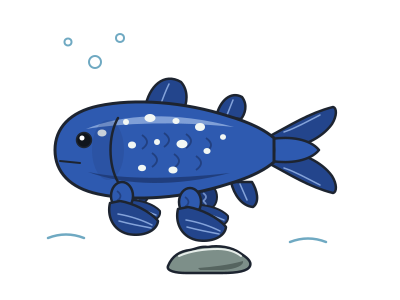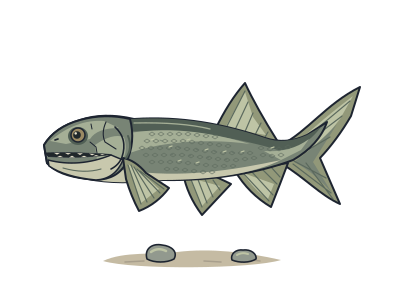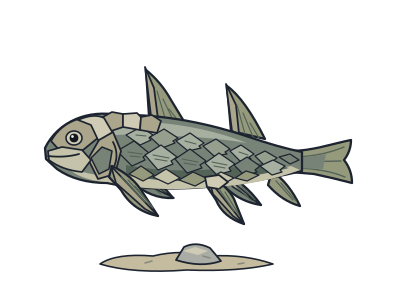
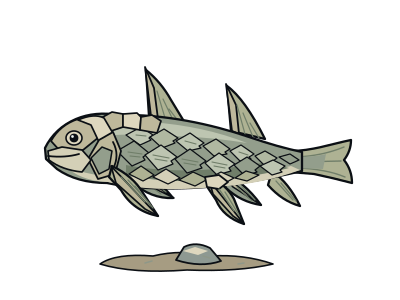
An extinct species
Guiyu †
Guiyu oneiros
The spiny ‘ghost fish’ that once held an ancient-fish record.
Lived about 424–422 million years ago.
You and the guiyu meet in the Bony fish and their descendants branch, shown at about 430 million years ago (on 24 November, in a calendar from life's shared ancestor to today).
Guiyu was a spiny Chinese ‘ghost fish’ that once held the record for the oldest known near-complete bony fish. It belonged to the same broad bony-fish family as us, though it was not established as a direct human ancestor. Its record, announced in 2009, was surpassed by an older discovery described in 2026.
It lived in Silurian seas about 424 to 422 million years ago. Its fossils came from rocks around Qujing in south-western China. Instead of offering only scattered bones, its connected skeleton let researchers study how different parts fitted together. The preserved bones showed spines on its shoulder supports. Supports for its rear pair of fins also included outer bony plates and spines—unlike the entirely internal supports for the rear paired fins of living bony fishes.
A later reconstruction put its full length at about 35 centimetres, a little longer than a school ruler. That length was an estimate: the main fossil preserved only about 26 centimetres, and its tail was missing.
Interlocking scales
Neighbouring scales along its sides fitted together with tiny pegs and sockets.
A plated back
Three bony plates ran along its back behind the head. The third carried the first back-fin spine.
Pointed teeth
Bones inside its lower jaw carried sharp, tusk-like teeth.