A species
Rosy feather star
Antedon bifida
A sea-lily relative that lets go and swims
You and the rosy feather star meet in the Starfish, sea squirts and us branch, shown at about 560 million years ago (on 13 November, in a calendar from life's shared ancestor to today).
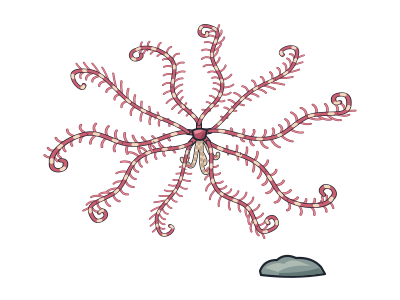
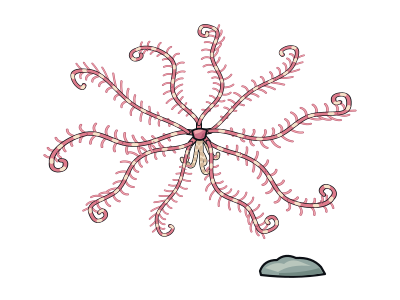
Think of the rosy feather star as a sea lily that has let go of its stalk. The connection is real: feather stars and sea lilies belong to the same animal group, whose relatives include starfish and sea urchins. When young, this animal attaches to the seabed on a short stalk. Later, it detaches and can swim by raising and lowering alternate arms.
Its usual ten arms begin as five main arms, each dividing in two. Small branches along their sides give them a feathery outline. These are not bird feathers, and the animal is not a plant. Tiny tube feet on the arms catch tiny plankton—organisms drifting with water currents—and help carry food towards the mouth at its centre.
Swimming trips are short, and it can crawl too. Much of the time, it grips a surface with short, movable hooks beneath its body. These hold it in place without fixing it there permanently: a useful difference from the stalk it had when young.
Not always rosy
Individuals can be red, pink, orange or yellow, often with bands or mottled patches.
Young held close
Females hold their developing young in a net of mucus on their arm branches, keeping their arms close together.
Replacement arms
Broken arms can regrow.