An extinct species
Charnia †
Charnia masoni
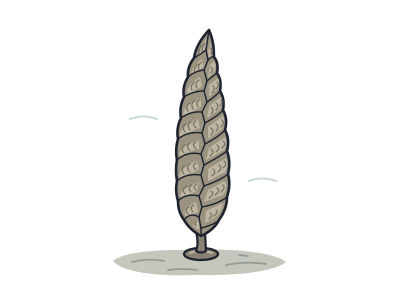
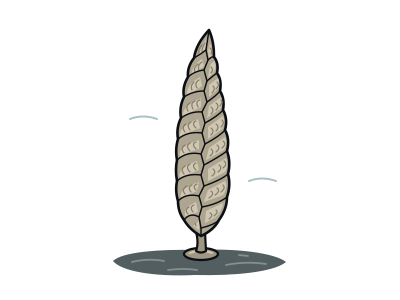
Fern-shaped, found by a schoolgirl, named after a schoolboy.
Lived about 570–550 million years ago.
You and the charnia meet in the Animals branch, shown at about 700 million years ago (on 1 November, in a calendar from life's shared ancestor to today).
A fern-shaped fossil from the deep sea was spotted by a schoolgirl, then named after a schoolboy. Tina Negus noticed it in Charnwood Forest, England, in 1956, but her teacher dismissed her report. Roger Mason brought it to scientific attention in 1957, and the species was named after him.
It lived about 570 to 550 million years ago, though some reported fossils may be younger. Despite its leafy shape, it was not a fern. It belonged to the rangeomorphs, an entirely extinct group with branching, leaf-shaped bodies. It was probably an early animal, although its exact place in the animal family tree remained uncertain. The original English population lived on the sea floor, too deep for enough sunlight to support a fern.
Its branches divided into smaller branches, making a repeating pattern. Most fossils recorded impressions or natural casts of a soft body, not bones or shells. Some also preserved a disc-shaped attachment base and a short connection to the leafy part. These fossils mattered because they provided convincing evidence of large organisms in rocks older than the Cambrian period.
Recognition at last
Tina Negus's contribution was publicly recognised in 2007, at the discovery's fiftieth-anniversary celebration.
Not matching pairs
Its two rows of branches alternated along a zig-zag centre line rather than forming matching left and right pairs.
Underwater avalanches
The rocks surrounding the original fossils formed from sediment carried by underwater avalanches of water, sand and silt.