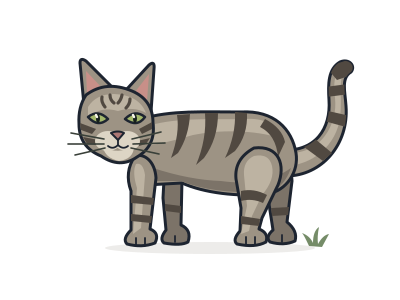
An exploration group
Domestic cats
Felis catus
Ordinary cats came before pedigree breeds.
Branches combine study-specific genetic affinities and documented breed-development histories. They are browsing groups, not a complete pedigree or dated evolutionary tree. Crossbreeding connects different branches, and similar coats can arise independently.
Return to the tree of life →Most domestic cats are random-bred: their mating was not organised to maintain a breed. They are not automatically mixtures of modern pedigree breeds. Much formal breed development happened from the 1800s onwards. These breeds are all domestic cats, not separate species.
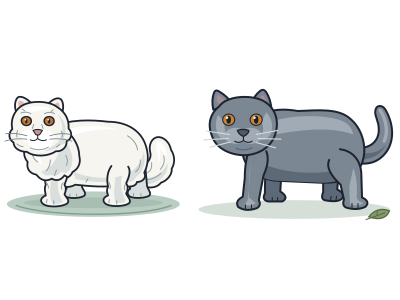
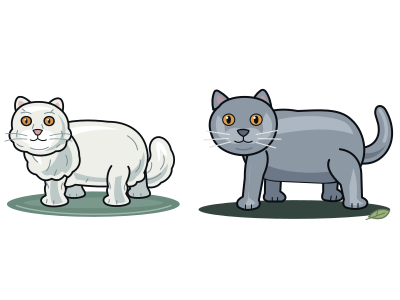
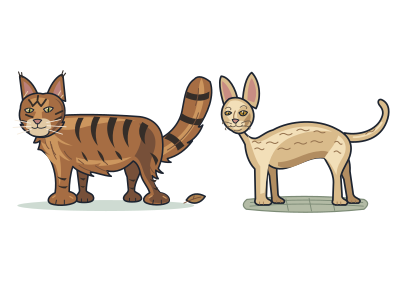
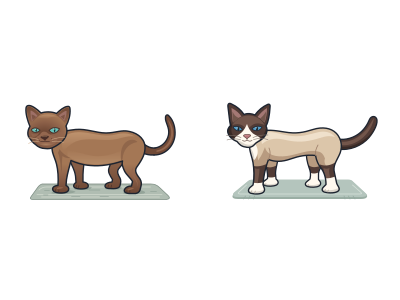
Domestic cats descend from African wildcats. The African wildcat shown beside this group is their wild ancestral relative, not another domestic breed. Breeders have mainly selected cats for looks, including coat colour, hair length and hair texture. Some breed histories include documented crosses. British Shorthairs, for example, were developed from non-pedigree shorthair cats, with later contributions from Persians and other breeds.
The branches combine study-informed genetic affinities with documented breeding histories. Some smaller groups follow closely connected breed development, such as Abyssinian and Somali or Manx and Cymric. Others compare independent changes, such as different routes to curly or sparse coats. Siamese-influenced breeds have their own browsing group because their documented crosses involve several contributors. No heading is a complete pedigree, and a recognition date is not an evolutionary split. The separate history follows the evidence for early human–cat relationships and later dispersal.
More variety outside breeds
Random-bred cats showed especially high genetic variation in the 2018 comparison. Several pedigree breeds had much less.
Tabby is a pattern
Tabby is not a breed. British Shorthairs alone can have striped, spotted, ticked or swirling tabby coats.
A Crystal Palace gathering
The Crystal Palace in London hosted a landmark cat show in 1871.
Explore this group
Study attribution
Gandolfi et al. (2018), Scientific Reports 8:7024 · CC-BY-4.0. Original explanation of study-specific similarity; editorial group headings are explicitly not clades or geography of origin. No study photos imported.
CFA, TICA and GCCF breed histories. Original summaries of documented breeding programmes and registry distinctions. Per-page sources identify the relevant breed histories; no standards, source prose or photographs reproduced.
Gandolfi et al. (2010): Sphynx and Devon Rex mutations in KRT71. Independent factual explanation of distinct coat variants, not a breed pedigree. No source imagery or text reproduced.
Selection Signatures Reveal Candidate Genes for the Cornish Rex Breed-Specific Phenotype (2024). Factual contrast between LPAR6-associated Cornish coat and KRT71-associated Devon/Sphynx coats. No figures or measurements copied.
Selected facts/group membership adapted; simplified layout and illustrations by Lifetree.