An exploration group
Intermediate study affinities
Gandolfi et al. 2018
Linked by genetic similarity, not a line of descent
These are editorial browsing groups, informed by Gandolfi et al. 2018 genetic-structure analyses. They are not rooted clades, direct ancestry, or a map of breed origins. Admixture and incomplete sampling limit every grouping.
Return to the tree of life →A 2018 study found a broad spread of genetic similarity across cat breeds. Turkish Angoras and Turkish Vans occupied intermediate positions between its Eastern and Western groupings. Abyssinians also clustered with breeds near the middle, despite their different coats and body shapes. Here, “intermediate” does not mean an ancestral breed or a halfway stage in evolution.
Think of this page as a browsing shelf, not a family tree showing lines of descent. Its heading and membership are editorial choices informed by the study. Neighbouring breeds are not shown as ancestors and descendants, and the layout does not establish particular historical crosses. Documented breed histories are separate evidence.
Somali has a documented connection to Abyssinian breeding: longhaired kittens in those lines became the basis of a separately named breed. Their shared branch follows that history; it is not a claim that the 2018 study established this exact nested group. Neither the name Abyssinian nor Somali settles the geographic origin of the underlying cats. Different views of genetic data can place breeds beside different neighbours; the diagram remains a guide to selected evidence.
A pattern, not proof
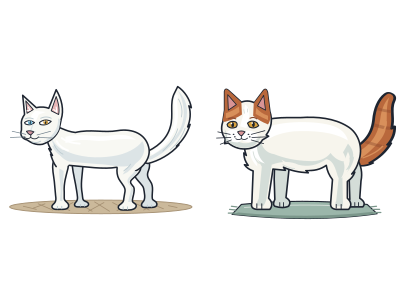
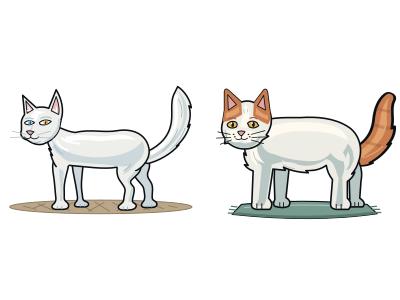
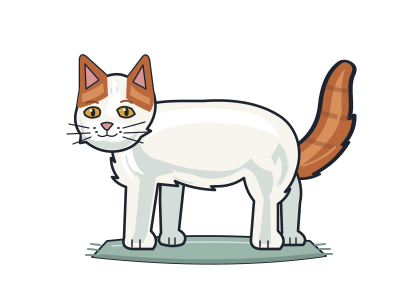
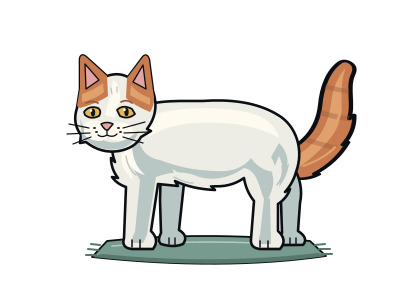
Turkish Vans are mostly white, with colour concentrated on the head and tail. Other breeds can have this pattern too, so markings alone do not establish a cat’s breed.
Colour in bands
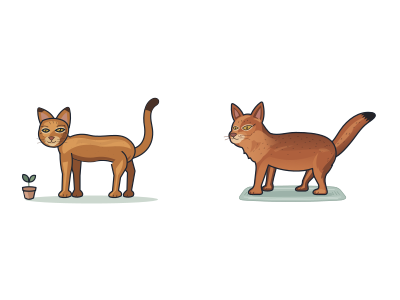
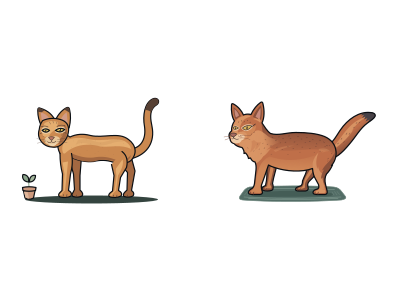
An Abyssinian’s finely flecked coat comes from individual hairs carrying alternating bands of lighter and darker colour.
A documented breeding connection
Turkish Angoras were historically used in Persian breeding programmes. A preservation programme at Ankara Zoo helped maintain the Angora breed.
Explore this group
Study attribution
Gandolfi et al. (2018), Scientific Reports 8:7024 · CC-BY-4.0. Original explanation of study-specific similarity; editorial group headings are explicitly not clades or geography of origin. No study photos imported.
CFA, TICA and GCCF breed histories. Original summaries of documented breeding programmes and registry distinctions. Per-page sources identify the relevant breed histories; no standards, source prose or photographs reproduced.
Gandolfi et al. (2010): Sphynx and Devon Rex mutations in KRT71. Independent factual explanation of distinct coat variants, not a breed pedigree. No source imagery or text reproduced.
Selection Signatures Reveal Candidate Genes for the Cornish Rex Breed-Specific Phenotype (2024). Factual contrast between LPAR6-associated Cornish coat and KRT71-associated Devon/Sphynx coats. No figures or measurements copied.
Selected facts/group membership adapted; simplified layout and illustrations by Lifetree.