A domestic breed
British Longhair
Felis catus
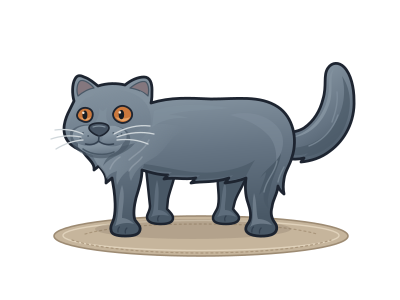
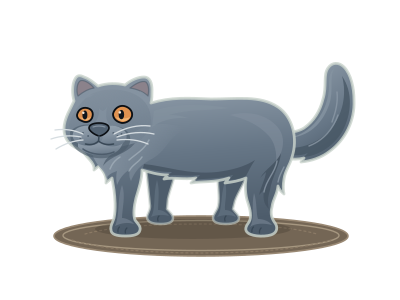
A British Shorthair build with a long coat
Branches combine study-specific genetic affinities and documented breed-development histories. They are browsing groups, not a complete pedigree or dated evolutionary tree. Crossbreeding connects different branches, and similar coats can arise independently.
Return to the tree of life →The British Longhair’s story began with British Shorthair breeders crossing their cats with Persians. Those crosses helped bring long coats into British Shorthair breeding lines. Look past the extra fur and you’ll see the family resemblance: a sturdy body and a round face. The Longhair’s dense coat stands out from its body.
Long-haired kittens can turn up in British Shorthair litters. A short-haired cat can pass on a version of a gene for long hair without having a long coat itself. A long coat alone doesn’t tell you a cat’s breed or prove it has Persian ancestors.
The diagram puts the two British breeds side by side. Their positions don’t show a line of descent or trace every cross. In a 2018 DNA study, the British Shorthairs in the study grouped closely with Persians. The researchers didn’t list British Longhairs as a separate group, so the result doesn’t directly describe them.
Origins
British Shorthairs were scarce after the Second World War. Breeders widened the breeding pool by crossing them with other cats, including Russian Blues and Chartreux.
Original purpose
Most long-haired kittens went to pet homes. Some enthusiasts wanted to develop the long-coated cats as a breed of their own, so they formed a club and asked the UK’s Governing Council of the Cat Fancy to recognise it.
Recognition
In May 2009, The International Cat Association made the breed eligible to compete for its championship titles. That date marks a decision by one cat association, not the start of the breed.
Study attribution
Gandolfi et al. (2018), Scientific Reports 8:7024 · CC-BY-4.0. Original explanation of study-specific similarity; editorial group headings are explicitly not clades or geography of origin. No study photos imported.
CFA, TICA and GCCF breed histories. Original summaries of documented breeding programmes and registry distinctions. Per-page sources identify the relevant breed histories; no standards, source prose or photographs reproduced.
Gandolfi et al. (2010): Sphynx and Devon Rex mutations in KRT71. Independent factual explanation of distinct coat variants, not a breed pedigree. No source imagery or text reproduced.
Selection Signatures Reveal Candidate Genes for the Cornish Rex Breed-Specific Phenotype (2024). Factual contrast between LPAR6-associated Cornish coat and KRT71-associated Devon/Sphynx coats. No figures or measurements copied.
Selected facts/group membership adapted; simplified layout and illustrations by Lifetree.