A domestic breed
British Shorthair
Felis catus
A British breed with Persian connections
These are editorial browsing groups, informed by Gandolfi et al. 2018 genetic-structure analyses. They are not rooted clades, direct ancestry, or a map of breed origins. Admixture and incomplete sampling limit every grouping.
Return to the tree of life →The British Shorthair has a real connection to the Persian beyond its position on this page. After wartime losses, breeders used other cats, including Persians, to rebuild its breeding lines. Those crosses introduced long hair, and long-haired kittens can still appear. This is a domestic cat breed, not a separate species.
The British Longhair sits beside the Shorthair here because their breeding histories are connected. The wider group draws on a 2018 DNA study in which British Shorthairs grouped with Persians, Selkirk Rexes and Scottish Folds. British Longhairs were not listed separately in that study. The paired branch uses breed history, not a separately measured result for the Longhair.
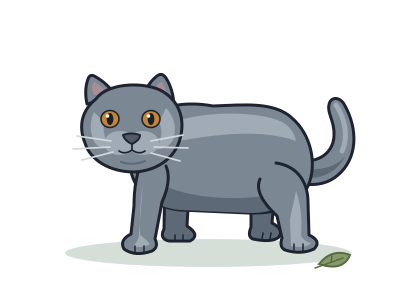
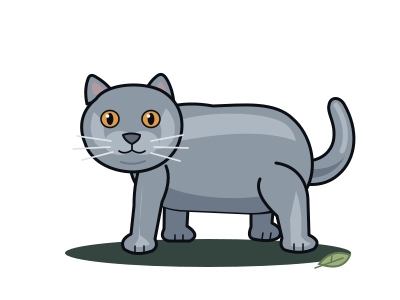
The familiar British Blue is grey rather than bright blue, but this breed has many other colours and patterns. These include tabby stripes, tortoiseshell and white patches. Males are generally larger than females, and mature males develop fuller cheeks.
Origins
Developed in Britain from ordinary short-haired domestic cats. Harrison Weir helped shape its early breed standard through selective breeding.
Original purpose
Earlier cats hunted around barns before the breed became established as a pedigree companion and show cat.
Recognition
The Cat Fanciers’ Association granted championship status in 1980. This was a registry milestone, not the breed’s origin.
Study attribution
Gandolfi et al. (2018), Scientific Reports 8:7024 · CC-BY-4.0. Original explanation of study-specific similarity; editorial group headings are explicitly not clades or geography of origin. No study photos imported.
CFA, TICA and GCCF breed histories. Original summaries of documented breeding programmes and registry distinctions. Per-page sources identify the relevant breed histories; no standards, source prose or photographs reproduced.
Gandolfi et al. (2010): Sphynx and Devon Rex mutations in KRT71. Independent factual explanation of distinct coat variants, not a breed pedigree. No source imagery or text reproduced.
Selection Signatures Reveal Candidate Genes for the Cornish Rex Breed-Specific Phenotype (2024). Factual contrast between LPAR6-associated Cornish coat and KRT71-associated Devon/Sphynx coats. No figures or measurements copied.
Selected facts/group membership adapted; simplified layout and illustrations by Lifetree.