A domestic breed
Turkish Van
Felis catus
A substantial domestic cat with a distinctive white-and-colour coat.
These are editorial browsing groups, informed by Gandolfi et al. 2018 genetic-structure analyses. They are not rooted clades, direct ancestry, or a map of breed origins. Admixture and incomplete sampling limit every grouping.
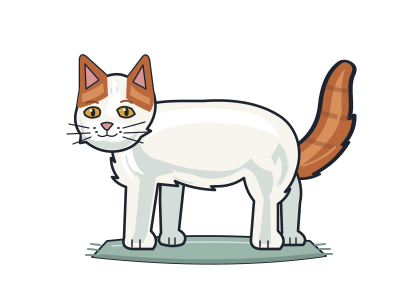
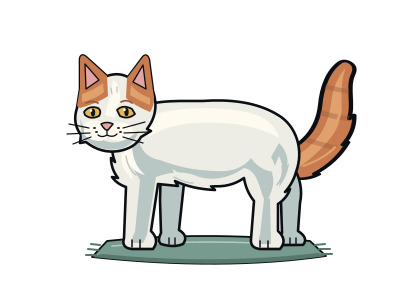
Return to the tree of life →The Turkish Van and Turkish Angora have similar names, but they are different domestic-cat breeds. Neither is a separate species. The Van has a sturdy, moderately long body, a broad chest and muscular legs, rather than the Angora’s finer-boned outline.
Its familiar coat is mostly white, with coloured markings on the head and a coloured, brush-like tail. Small patches on the body are allowed too. The soft, medium-long fur becomes shorter in summer and fuller in winter. Eyes may be amber, blue or one of each: different-coloured eyes are possible, not required.
Here, the Van sits beside the Turkish Angora and Abyssinian in a browsing group chosen by the editors and informed by research on inherited similarities. This layout does not show ancestors and descendants, establish a sister-group relationship, or map where breeds began. Nor does being neighbours prove a historical cross. Documented breed development is a separate question, supported by historical records rather than a position in this diagram.
Origins
The International Cat Association traces the modern breed’s development in Britain to cats brought from Turkey by Laura Lushington and Sonia Halliday in the mid-1950s.
Original purpose
The Governing Council of the Cat Fancy describes these cats as domestic pets in Turkey before their introduction to Britain. This supports a companion role, not a special fishing job.
Recognition
The Cat Fanciers’ Association first recognised the breed in 1988 and granted championship status in 1994. These were milestones in its acceptance for registration and shows, not origin dates.
Study attribution
Gandolfi et al. (2018), Scientific Reports 8:7024 · CC-BY-4.0. Original explanation of study-specific similarity; editorial group headings are explicitly not clades or geography of origin. No study photos imported.
CFA, TICA and GCCF breed histories. Original summaries of documented breeding programmes and registry distinctions. Per-page sources identify the relevant breed histories; no standards, source prose or photographs reproduced.
Gandolfi et al. (2010): Sphynx and Devon Rex mutations in KRT71. Independent factual explanation of distinct coat variants, not a breed pedigree. No source imagery or text reproduced.
Selection Signatures Reveal Candidate Genes for the Cornish Rex Breed-Specific Phenotype (2024). Factual contrast between LPAR6-associated Cornish coat and KRT71-associated Devon/Sphynx coats. No figures or measurements copied.
Selected facts/group membership adapted; simplified layout and illustrations by Lifetree.