A domestic breed
Turkish Angora
Felis catus
A slender domestic breed with a documented breeding history—not a branch of descent.
These are editorial browsing groups, informed by Gandolfi et al. 2018 genetic-structure analyses. They are not rooted clades, direct ancestry, or a map of breed origins. Admixture and incomplete sampling limit every grouping.
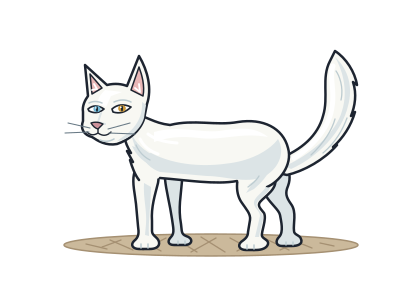
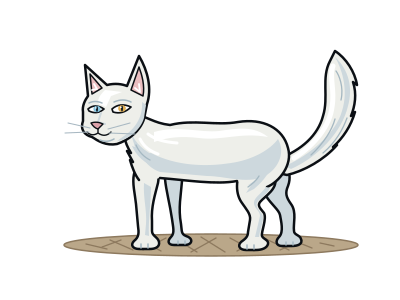
Return to the tree of life →The Turkish Angora is a domestic-cat breed, not a separate species. Its long, slender body is muscular, with large upright ears and a flowing tail. White is traditional, but these cats also come in many other colours and patterns. Their summer coat is shorter; winter can bring a fuller collar of fur around the neck.
The breed's development includes documented crosses with Persians. These helped make Turkish Angoras scarce as a separately maintained show breed. A pair obtained from a zoo in 1962 helped establish a new breeding programme in the United States. That recorded history matters independently of where the breed appears in this diagram.
Here, the Turkish Angora sits beside the Turkish Van and Abyssinian. This is an editorial browsing arrangement informed by research comparing cats' DNA, not a rooted family tree. Neighbouring breeds are not shown as ancestors, descendants or sister groups. Nor does their position map where they originated. The diagram cannot establish those relationships, but that does not mean documented historical crosses never happened.
Origins
The breed comes from Ankara in Türkiye. The city's former name, Angora, gives the breed its name.
Original purpose
The documented preservation programme aimed to save a valued Turkish domestic breed. The reviewed histories do not establish a specialised original working role.
Recognition
The Cat Fanciers' Association began registering the breed separately in 1968. Championship eligibility followed for white cats in 1973 and other accepted colours in 1978. These are registry milestones, not origin dates.
Study attribution
Gandolfi et al. (2018), Scientific Reports 8:7024 · CC-BY-4.0. Original explanation of study-specific similarity; editorial group headings are explicitly not clades or geography of origin. No study photos imported.
CFA, TICA and GCCF breed histories. Original summaries of documented breeding programmes and registry distinctions. Per-page sources identify the relevant breed histories; no standards, source prose or photographs reproduced.
Gandolfi et al. (2010): Sphynx and Devon Rex mutations in KRT71. Independent factual explanation of distinct coat variants, not a breed pedigree. No source imagery or text reproduced.
Selection Signatures Reveal Candidate Genes for the Cornish Rex Breed-Specific Phenotype (2024). Factual contrast between LPAR6-associated Cornish coat and KRT71-associated Devon/Sphynx coats. No figures or measurements copied.
Selected facts/group membership adapted; simplified layout and illustrations by Lifetree.