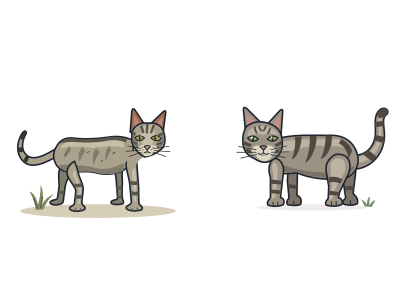
An exploration group
Cats: domestication and breeds
Felis
The wildcat connection behind the household cat.
Branches combine study-specific genetic affinities and documented breed-development histories. They are browsing groups, not a complete pedigree or dated evolutionary tree. Crossbreeding connects different branches, and similar coats can arise independently.
Return to the tree of life →A household cat’s family story leads back to the African wildcat. Domestic cats descend from past populations of these wildcats, which is why the two branches sit together here. This focused exhibit follows that connection into domestication and breeds. It is a browsing guide, not a complete catalogue of the wider group.
Within the domestic-cat branch, a breed is not a separate species. The breed browsing groups are editorial guides informed by a 2018 study comparing more than 2,000 cats, including 41 breeds and four wild cat species. The researchers found broad patterns of genetic similarity, with groups in between rather than completely separate breed boxes. Much modern cat breeding has selected appearance, including coat colour, length and texture.
The nested branches combine those study affinities with documented breed-development histories. Follow the Siamese and Oriental relatives, compare Persian-derived coats, or explore how separate mutations changed the fur of Cornish Rex, Devon Rex and Sphynx cats. The diagram has no dated ancestral root for modern breeds: crossbreeding can connect several branches. The history trail follows selected evidence from early human–cat relationships to recent pedigree breeding.
Pattern, not breed
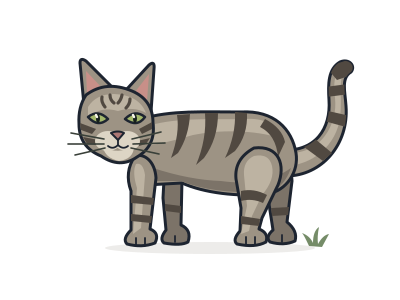
Tabby, calico and tortoiseshell describe coat patterns, not breeds.
Count the toes
Domestic cats usually have five toes on each front paw and four on each back paw. Some have extra toes.
Worldwide travellers
People have carried domestic cats around the world. They occur on every continent except Antarctica.
Explore this group
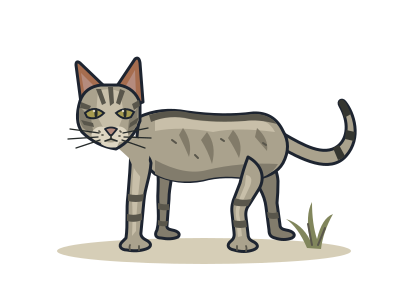
Study attribution
Gandolfi et al. (2018), Scientific Reports 8:7024 · CC-BY-4.0. Original explanation of study-specific similarity; editorial group headings are explicitly not clades or geography of origin. No study photos imported.
CFA, TICA and GCCF breed histories. Original summaries of documented breeding programmes and registry distinctions. Per-page sources identify the relevant breed histories; no standards, source prose or photographs reproduced.
Gandolfi et al. (2010): Sphynx and Devon Rex mutations in KRT71. Independent factual explanation of distinct coat variants, not a breed pedigree. No source imagery or text reproduced.
Selection Signatures Reveal Candidate Genes for the Cornish Rex Breed-Specific Phenotype (2024). Factual contrast between LPAR6-associated Cornish coat and KRT71-associated Devon/Sphynx coats. No figures or measurements copied.
Selected facts/group membership adapted; simplified layout and illustrations by Lifetree.