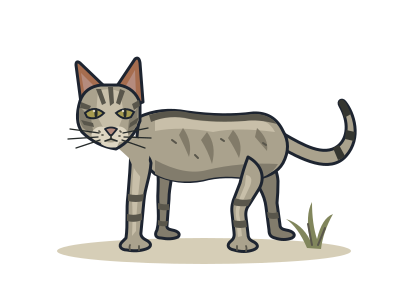
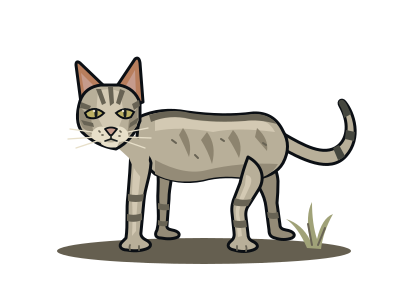
A species
African wildcat
Felis lybica
The wild family behind your house cat
Branches combine study-specific genetic affinities and documented breed-development histories. They are browsing groups, not a complete pedigree or dated evolutionary tree. Crossbreeding connects different branches, and similar coats can arise independently.
Return to the tree of life →Your house cat’s wild roots lie in African wildcat populations from North Africa and the Near East, rather than in the European wildcat. This ancestry concerns past populations: a wildcat alive today is not the particular animal that founded domestic cats. Exactly where and when cats became domestic is still uncertain.
The African wildcat is a wild species, not a domestic breed or simply a pet living loose. Despite its name, it lives in parts of Asia too. Compared with the European wildcat, it generally has a lighter build and a slimmer tail that narrows towards the tip.
Rats and mice are important food, though it also hunts birds, reptiles, frogs and large insects. It is mainly active at night. Most live alone, apart from mothers staying with their kittens.
This display is a browsing guide, not proof of a direct ancestral chain or a map of breed origins. The wildcat ancestry of domestic cats comes from separate research, not simply from placing the two beside each other.
Sitting tall
Long front legs give it a noticeably upright sitting posture.
Borrowed shelter
It shelters in burrows made by other animals, including foxes and aardvarks.
Small families
A litter usually contains about two to four kittens, though larger litters occur.
Study attribution
Gandolfi et al. (2018), Scientific Reports 8:7024 · CC-BY-4.0. Original explanation of study-specific similarity; editorial group headings are explicitly not clades or geography of origin. No study photos imported.
CFA, TICA and GCCF breed histories. Original summaries of documented breeding programmes and registry distinctions. Per-page sources identify the relevant breed histories; no standards, source prose or photographs reproduced.
Gandolfi et al. (2010): Sphynx and Devon Rex mutations in KRT71. Independent factual explanation of distinct coat variants, not a breed pedigree. No source imagery or text reproduced.
Selection Signatures Reveal Candidate Genes for the Cornish Rex Breed-Specific Phenotype (2024). Factual contrast between LPAR6-associated Cornish coat and KRT71-associated Devon/Sphynx coats. No figures or measurements copied.
Selected facts/group membership adapted; simplified layout and illustrations by Lifetree.