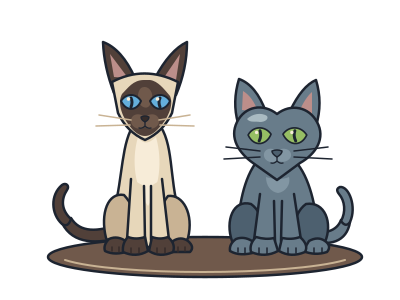
An exploration group
Eastern study affinities
Gandolfi et al. 2018
A DNA-similarity neighbourhood, not an ancestry chart.
These are editorial browsing groups, informed by Gandolfi et al. 2018 genetic-structure analyses. They are not rooted clades, direct ancestry, or a map of breed origins. Admixture and incomplete sampling limit every grouping.
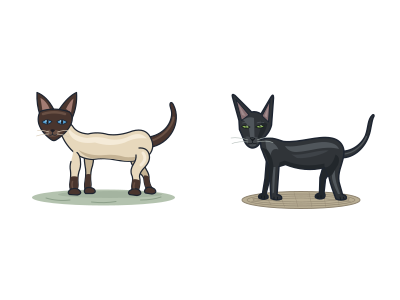
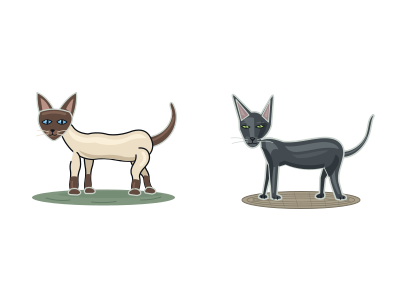
Return to the tree of life →Siamese, Oriental Shorthair, Peterbald, Burmese, Birman and Korat appear here partly through evidence from DNA comparisons. Oriental, Siamese, Burmese, Korat and Birman lay towards one end of a 2018 study’s similarity plots, opposite the Persian family. Smaller branches follow documented breed development, including Balinese and Oriental Longhair, the moderate Thai, and breeds with Burmese contributions. These histories are separate evidence; the study did not establish the whole browsing group as one genetic clade.
Think of this as a guide to similarities, not a chain of ancestors. Neighbouring breeds are not shown as ancestors and descendants, and the groups beside this one are not established sister groups. The layout does not establish individual family histories, breeding direction or where breeds began. “Eastern” is a browsing label, not a birthplace.
Documented breeding history is separate evidence, and it still matters. The Peterbald was developed in Russia from an Oriental Shorthair and a Donskoy. The Oriental breed’s modern development began in Europe. Those histories show why a breed’s position in a DNA-similarity diagram should not be mistaken for a map of its origins.
A wide comparison
The study compared DNA from about 2,000 cats, including representatives of 41 domestic breeds.
Birmans stood apart
Birman cats formed a particularly distinct group in the study’s similarity plots.
Not always bald
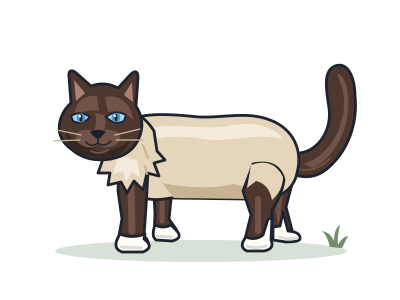
Peterbalds can have bare skin, peach-like fuzz, wiry hair or an ordinary coat. Some coats change as kittens grow.
Explore this group
Study attribution
Gandolfi et al. (2018), Scientific Reports 8:7024 · CC-BY-4.0. Original explanation of study-specific similarity; editorial group headings are explicitly not clades or geography of origin. No study photos imported.
CFA, TICA and GCCF breed histories. Original summaries of documented breeding programmes and registry distinctions. Per-page sources identify the relevant breed histories; no standards, source prose or photographs reproduced.
Gandolfi et al. (2010): Sphynx and Devon Rex mutations in KRT71. Independent factual explanation of distinct coat variants, not a breed pedigree. No source imagery or text reproduced.
Selection Signatures Reveal Candidate Genes for the Cornish Rex Breed-Specific Phenotype (2024). Factual contrast between LPAR6-associated Cornish coat and KRT71-associated Devon/Sphynx coats. No figures or measurements copied.
Selected facts/group membership adapted; simplified layout and illustrations by Lifetree.