A domestic breed
Korat
Felis catus
Silver-tipped fur, and a history beyond the diagram.
These are editorial browsing groups, informed by Gandolfi et al. 2018 genetic-structure analyses. They are not rooted clades, direct ancestry, or a map of breed origins. Admixture and incomplete sampling limit every grouping.
Return to the tree of life →The Korat is a breed of domestic cat, not a separate species. Here it sits near Siamese and Burmese cats because of genetic similarities studied in sampled cats. These browsing groups are not branches showing descent or a map of breed origins. Neighbouring positions do not establish ancestry or identify the closest relatives.
The breed’s documented development is a separate story. Jean Johnson imported the first documented pair into the United States in 1959. British registry records describe those cats being crossed with imported Thai Siamese, with only blue offspring registered as Korats. That history comes from breed records; the diagram itself does not establish those crosses.
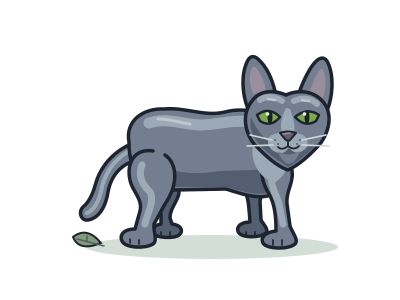
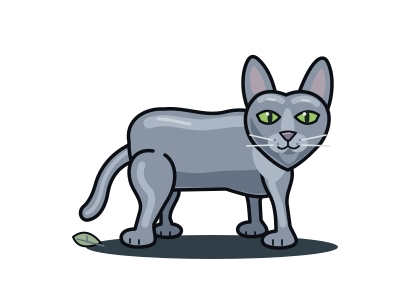
The recognised coat is blue-grey with silver tips, rather than bright blue. Each hair has a lighter root, a darker blue middle and a silver tip. Large ears have broad bases and rounded tips. The muzzle is well developed, neither sharply pointed nor square.
Origins
The Korat comes from Thailand, where it is also called Si-Sawat.
Original purpose
Its documented traditional role was as a good-luck gift, including gifts to brides. This was a cultural role, not a proven original breeding purpose.
Recognition
The Governing Council of the Cat Fancy allowed Korats to compete for championship titles in 1984. This was a recognition milestone, not the breed’s origin date.
Study attribution
Gandolfi et al. (2018), Scientific Reports 8:7024 · CC-BY-4.0. Original explanation of study-specific similarity; editorial group headings are explicitly not clades or geography of origin. No study photos imported.
CFA, TICA and GCCF breed histories. Original summaries of documented breeding programmes and registry distinctions. Per-page sources identify the relevant breed histories; no standards, source prose or photographs reproduced.
Gandolfi et al. (2010): Sphynx and Devon Rex mutations in KRT71. Independent factual explanation of distinct coat variants, not a breed pedigree. No source imagery or text reproduced.
Selection Signatures Reveal Candidate Genes for the Cornish Rex Breed-Specific Phenotype (2024). Factual contrast between LPAR6-associated Cornish coat and KRT71-associated Devon/Sphynx coats. No figures or measurements copied.
Selected facts/group membership adapted; simplified layout and illustrations by Lifetree.