A domestic breed
Birman
Felis catus
White paws, dark markings and a study-based neighbourhood.
These are editorial browsing groups, informed by Gandolfi et al. 2018 genetic-structure analyses. They are not rooted clades, direct ancestry, or a map of breed origins. Admixture and incomplete sampling limit every grouping.
Return to the tree of life →The Birman is a domestic cat breed, shown here near Siamese, Burmese and Korat cats because of similarities found in a genetic study. This is a browsing group, not a branch showing descent. Neighbouring breeds are not presented as ancestors and descendants, and the layout does not map where breeds began. It does not settle separate historical questions about crosses used to develop breeds.
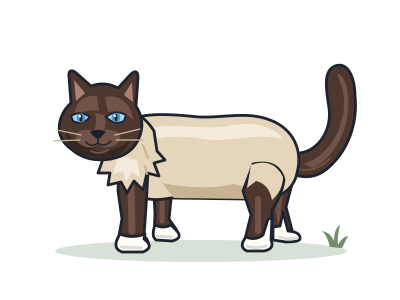
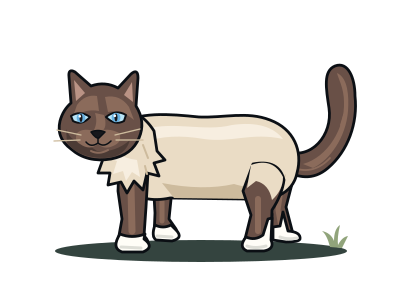
Look for a pale body with darker fur on the face, ears, legs and tail. This is called a pointed colour pattern. All four paws have white markings, like little socks. Behind the back paws, the white narrows into tips that reach up the legs.
The body is substantial and somewhat stocky, with strong bones and muscular legs. Females are generally smaller than males. This is a domestic breed that lives with people, not a wild cat with its own natural range.
Origins
The modern Birman breed was established in France. Its earliest beginnings are poorly documented.
Original purpose
TICA describes the story of Birmans living with temple priests in Burma, now Myanmar, as a legend—not an established original working role.
Recognition
Birmans were recognised in France in 1925 and by Britain’s Governing Council of the Cat Fancy in 1966. These are recognition dates, not dates when the breed began.
Study attribution
Gandolfi et al. (2018), Scientific Reports 8:7024 · CC-BY-4.0. Original explanation of study-specific similarity; editorial group headings are explicitly not clades or geography of origin. No study photos imported.
CFA, TICA and GCCF breed histories. Original summaries of documented breeding programmes and registry distinctions. Per-page sources identify the relevant breed histories; no standards, source prose or photographs reproduced.
Gandolfi et al. (2010): Sphynx and Devon Rex mutations in KRT71. Independent factual explanation of distinct coat variants, not a breed pedigree. No source imagery or text reproduced.
Selection Signatures Reveal Candidate Genes for the Cornish Rex Breed-Specific Phenotype (2024). Factual contrast between LPAR6-associated Cornish coat and KRT71-associated Devon/Sphynx coats. No figures or measurements copied.
Selected facts/group membership adapted; simplified layout and illustrations by Lifetree.