A domestic breed
Havana Brown
Felis catus
A solid brown coat with a Siamese connection
Branches combine study-specific genetic affinities and documented breed-development histories. They are browsing groups, not a complete pedigree or dated evolutionary tree. Crossbreeding connects different branches, and similar coats can arise independently.
Return to the tree of life →The English breeding programme began in the early 1950s. Cats from those early crosses reached the United States by the middle of the decade. Breeders there kept the distinctive head shape. Britain’s Governing Council of the Cat Fancy uses Havana for the solid brown Oriental Shorthair, which has a more wedge-shaped head.
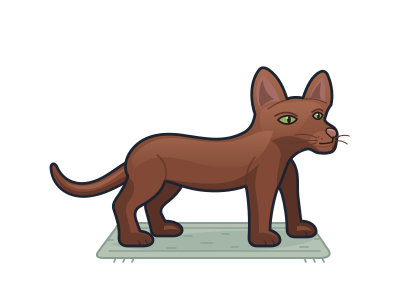
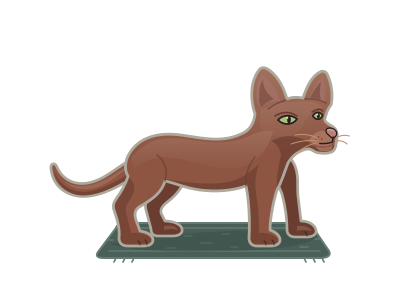
Look for a warm chestnut-brown coat, brown whiskers and oval green eyes. The round-tipped ears tilt forwards. The muzzle sticks out from a head that is longer than it is wide, and the face narrows just behind the base of the whiskers. From the side, a strong chin makes the front of the face look almost square.
On a chart from a 2018 DNA study, the Havana Brown fell towards the same end as the Siamese, Korat and Birman cats tested. That helps explain why they appear near each other here. The diagram doesn’t show where or when breeds began, or whether one neighbour descended from another. The Siamese crosses are known from breeding records.
Origins
Elmtower Bronze Idol, the first Havana registered in England, was born in 1952. He was the only brown kitten in a litter of four. The other three were black.
Original purpose
Baroness von Ullmann and her fellow breeders took their cue from Siamese cats with chocolate-brown faces, ears, feet and tails. They wanted that same shade across the whole coat.
Recognition
The Cat Fanciers’ Association began registering Havana Browns in 1959 and let them compete for championship titles in 1964. The breed was already being developed before either decision.
Study attribution
Gandolfi et al. (2018), Scientific Reports 8:7024 · CC-BY-4.0. Original explanation of study-specific similarity; editorial group headings are explicitly not clades or geography of origin. No study photos imported.
CFA, TICA and GCCF breed histories. Original summaries of documented breeding programmes and registry distinctions. Per-page sources identify the relevant breed histories; no standards, source prose or photographs reproduced.
Gandolfi et al. (2010): Sphynx and Devon Rex mutations in KRT71. Independent factual explanation of distinct coat variants, not a breed pedigree. No source imagery or text reproduced.
Selection Signatures Reveal Candidate Genes for the Cornish Rex Breed-Specific Phenotype (2024). Factual contrast between LPAR6-associated Cornish coat and KRT71-associated Devon/Sphynx coats. No figures or measurements copied.
Selected facts/group membership adapted; simplified layout and illustrations by Lifetree.