A domestic breed
Burmilla
Felis catus
An unplanned litter from a Burmese and a Chinchilla Persian inspired a new breed.
Branches combine study-specific genetic affinities and documented breed-development histories. They are browsing groups, not a complete pedigree or dated evolutionary tree. Crossbreeding connects different branches, and similar coats can arise independently.
Return to the tree of life →The founding litter came from a lilac Burmese female and a Chinchilla Persian male. The Cat Fanciers’ Association identifies the mother as European Burmese. To develop the breed, breeders later paired cats from that litter with Burmese cats.
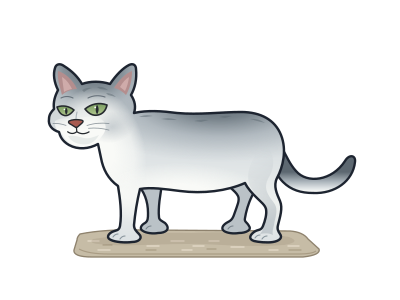
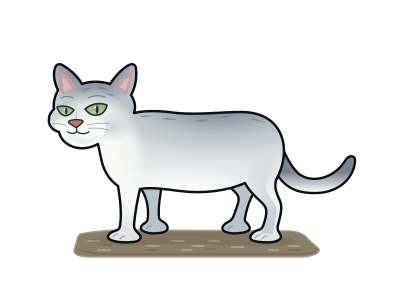
The Persian side brought the silver shading and the longer fur seen in some Burmillas. A shaded silver coat looks darker than a lightly tipped one because the dark colour covers more of each hair. In one shaded silver form, black tips darken the back, the chest stays white, and black lines frame the green eyes and brick-red nose.
The American Bombay also has Burmese ancestry, but it came from a separate breeding programme that crossed Burmese cats with black American Shorthairs. The diagram groups breeds for browsing. Sitting side by side does not establish a line of descent or tell you which breeds are closest in DNA.
Origins
The first litter had four kittens, all female. Each had short silver fur shaded with black.
Original purpose
Breeders set out to keep the Burmese head and body shape while developing a cat with silver-tipped fur.
Recognition
The Cat Fanciers’ Association accepted both short- and long-haired Burmillas for registration in 2011. Both became eligible to compete for championships in 2014.
Study attribution
Gandolfi et al. (2018), Scientific Reports 8:7024 · CC-BY-4.0. Original explanation of study-specific similarity; editorial group headings are explicitly not clades or geography of origin. No study photos imported.
CFA, TICA and GCCF breed histories. Original summaries of documented breeding programmes and registry distinctions. Per-page sources identify the relevant breed histories; no standards, source prose or photographs reproduced.
Gandolfi et al. (2010): Sphynx and Devon Rex mutations in KRT71. Independent factual explanation of distinct coat variants, not a breed pedigree. No source imagery or text reproduced.
Selection Signatures Reveal Candidate Genes for the Cornish Rex Breed-Specific Phenotype (2024). Factual contrast between LPAR6-associated Cornish coat and KRT71-associated Devon/Sphynx coats. No figures or measurements copied.
Selected facts/group membership adapted; simplified layout and illustrations by Lifetree.