A domestic breed
Bombay
Felis catus
A black-coated breed with Kentucky roots
Branches combine study-specific genetic affinities and documented breed-development histories. They are browsing groups, not a complete pedigree or dated evolutionary tree. Crossbreeding connects different branches, and similar coats can arise independently.
Return to the tree of life →Despite its name, the US Bombay began in Kentucky, not India. Herb and Suzanne Zwecker later developed more lines of Bombays by making new crosses between Burmese cats and American Shorthairs.
Burmese cats also helped give rise to the Burmilla, shown nearby. The branches group breeds for browsing. Being neighbours on the diagram does not show that one breed came from the other. The diagram does not trace every cross or tell us which breed is the Bombay’s closest relative.
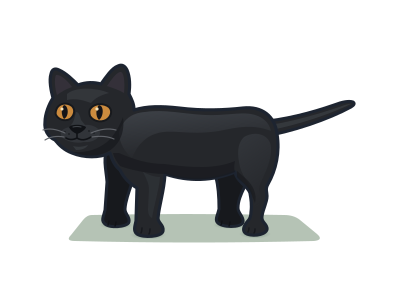
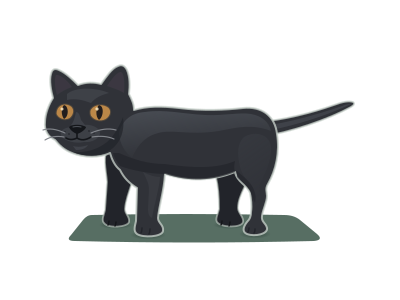
The US show standard describes a medium-sized, muscular adult with a short, glossy coat that is black down to the roots. The nose and paw pads are black too. The round eyes sit wide apart and range from gold to deep copper.
Origins
Nikki Horner led the original breeding work in Louisville. The Burmese cats she used in the crosses were deep brown.
Original purpose
Horner wanted a house cat that looked like a small black leopard. She exhibited early Bombays at cat shows while working to get the breed recognised.
Recognition
In June 1979, the International Cat Association made the Bombay eligible to compete for championships. That was a show milestone, not the date the breed began.
Study attribution
Gandolfi et al. (2018), Scientific Reports 8:7024 · CC-BY-4.0. Original explanation of study-specific similarity; editorial group headings are explicitly not clades or geography of origin. No study photos imported.
CFA, TICA and GCCF breed histories. Original summaries of documented breeding programmes and registry distinctions. Per-page sources identify the relevant breed histories; no standards, source prose or photographs reproduced.
Gandolfi et al. (2010): Sphynx and Devon Rex mutations in KRT71. Independent factual explanation of distinct coat variants, not a breed pedigree. No source imagery or text reproduced.
Selection Signatures Reveal Candidate Genes for the Cornish Rex Breed-Specific Phenotype (2024). Factual contrast between LPAR6-associated Cornish coat and KRT71-associated Devon/Sphynx coats. No figures or measurements copied.
Selected facts/group membership adapted; simplified layout and illustrations by Lifetree.