A domestic breed
European Burmese
Felis catus
The Burmese breed Britain shaped
Branches combine study-specific genetic affinities and documented breed-development histories. They are browsing groups, not a complete pedigree or dated evolutionary tree. Crossbreeding connects different branches, and similar coats can arise independently.
Return to the tree of life →The European Burmese and the Burmese both trace their history to Wong Mau. She was brought from Burma, now Myanmar, to the United States in 1930. Her dark brown descendants helped establish the American Burmese. American-bred Burmese later went to Britain, where breeders added colours such as red and cream.
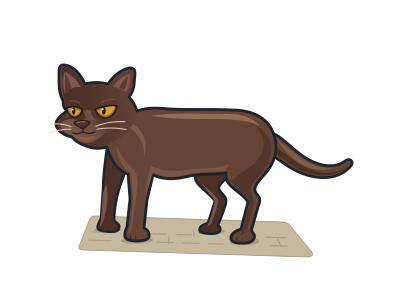
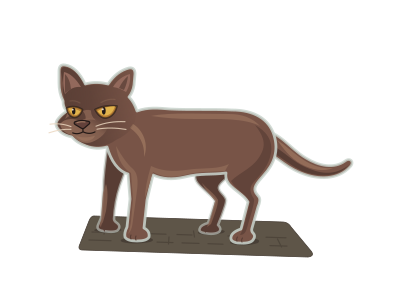
The Cat Fanciers’ Association describes the European Burmese as less compact than the Burmese it shows. It has a muscular body, a rounded chest and a short, glossy coat. The head is broad at the cheeks and tapers to a short, blunt wedge. In the show standard, the eyes are set well apart and their colour ranges from golden yellow to amber.
The diagram groups breeds for browsing. Being neighbours here doesn’t show that one breed came from another. Breed histories can tell us more: the Burmilla began with a mating between a European Burmese and a Persian.
Origins
One of Wong Mau’s first recorded mates was Tai Mau, a Siamese from Thailand. Their litter included kittens with Siamese colouring and brown kittens that looked like Wong Mau.
Original purpose
Breeders developed additional coat colours while retaining the muscular Burmese type. British lines later formed the basis of CFA’s separately named European Burmese.
Recognition
The Cat Fanciers’ Association accepted the breed for registration in June 1993. In February 2002 it approved the breed to compete for championship titles from 1 May that year. Neither decision marks the breed’s start.
Study attribution
Gandolfi et al. (2018), Scientific Reports 8:7024 · CC-BY-4.0. Original explanation of study-specific similarity; editorial group headings are explicitly not clades or geography of origin. No study photos imported.
CFA, TICA and GCCF breed histories. Original summaries of documented breeding programmes and registry distinctions. Per-page sources identify the relevant breed histories; no standards, source prose or photographs reproduced.
Gandolfi et al. (2010): Sphynx and Devon Rex mutations in KRT71. Independent factual explanation of distinct coat variants, not a breed pedigree. No source imagery or text reproduced.
Selection Signatures Reveal Candidate Genes for the Cornish Rex Breed-Specific Phenotype (2024). Factual contrast between LPAR6-associated Cornish coat and KRT71-associated Devon/Sphynx coats. No figures or measurements copied.
Selected facts/group membership adapted; simplified layout and illustrations by Lifetree.