A domestic breed
Burmese
Felis catus
A muscular cat breed with a documented Siamese connection.
These are editorial browsing groups, informed by Gandolfi et al. 2018 genetic-structure analyses. They are not rooted clades, direct ancestry, or a map of breed origins. Admixture and incomplete sampling limit every grouping.
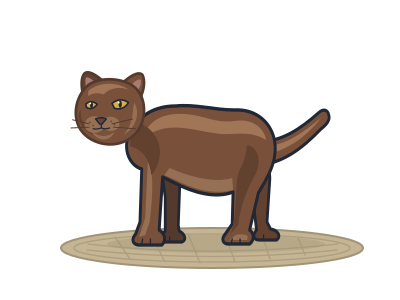
Return to the tree of life →The Burmese is a compact, muscular domestic cat breed. Siamese cats were used in its development. Males are generally larger than females.
The branch compares Burmese with European Burmese and two later breeding programmes. Bombay development used Burmese and American Shorthair cats; Burmilla began with a Burmese–Persian cross. Those connections come from breeding records. A single branch cannot show every contributor or the full history of each breed.
Not every Burmese is brown. Organisations that register pedigree cats recognise different sets of colours. Britain's main cat registry accepts ten standard colours, including red, cream and tortoiseshell. One registry's rules should not be treated as a description of every Burmese.
Origins
The modern breed was developed in the United States around Wong Mau, a brown female cat brought there in 1930. Later development also took place in Britain.
Original purpose
Early breeders aimed to reproduce Wong Mau's distinctive appearance. Companion and show cat is a suitable summary of the breed's role; the documented history does not establish a special working job.
Recognition
Britain's Governing Council of the Cat Fancy recognised Burmese in 1952. This was a registry milestone, not the breed's origin date.
Study attribution
Gandolfi et al. (2018), Scientific Reports 8:7024 · CC-BY-4.0. Original explanation of study-specific similarity; editorial group headings are explicitly not clades or geography of origin. No study photos imported.
CFA, TICA and GCCF breed histories. Original summaries of documented breeding programmes and registry distinctions. Per-page sources identify the relevant breed histories; no standards, source prose or photographs reproduced.
Gandolfi et al. (2010): Sphynx and Devon Rex mutations in KRT71. Independent factual explanation of distinct coat variants, not a breed pedigree. No source imagery or text reproduced.
Selection Signatures Reveal Candidate Genes for the Cornish Rex Breed-Specific Phenotype (2024). Factual contrast between LPAR6-associated Cornish coat and KRT71-associated Devon/Sphynx coats. No figures or measurements copied.
Selected facts/group membership adapted; simplified layout and illustrations by Lifetree.