An exploration group
Persian family affinities
Gandolfi et al. 2018
Genetic neighbours, not a ladder of ancestors
These are editorial browsing groups, informed by Gandolfi et al. 2018 genetic-structure analyses. They are not rooted clades, direct ancestry, or a map of breed origins. Admixture and incomplete sampling limit every grouping.
Return to the tree of life →Persian family affinities is a browsing group, not a chain of ancestors and descendants. A 2018 study found that Persians, British Shorthairs, Selkirk Rexes and Scottish Folds clustered close together in genetic-similarity plots. Another analysis also found shared genetic contributions linking these breeds. Cats with different-looking coats can have connections that appearance alone does not reveal.
The diagram does not show which breed came first, which breeds are each other’s closest relatives, or where they originated. These are domestic-cat breeds, not separate species. Mixed breeding histories and incomplete sampling limit what the results can tell us. Think of this study-group as a shelf for exploring similarities, rather than a formal branch of the tree of life.
Exotic Shorthairs are included through documented breed development, not a separately demonstrated Exotic cluster in the study. Their history includes Persian and American Shorthair crosses, followed by repeated breeding back to Persians. The nested Persian, Exotic and Himalayan branch adds the colourpoint history of Persian–Siamese breeding. British Shorthair and British Longhair have their own branch for their connected development. Registry treatment varies: CFA includes Himalayan within Persian, while TICA names it separately.
Long coat, compact cat
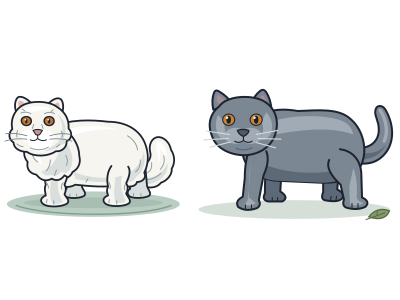
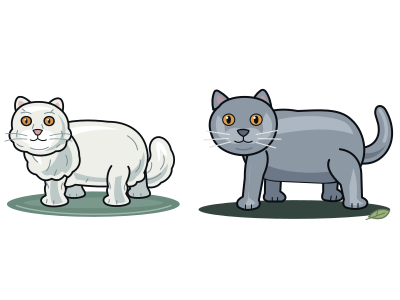
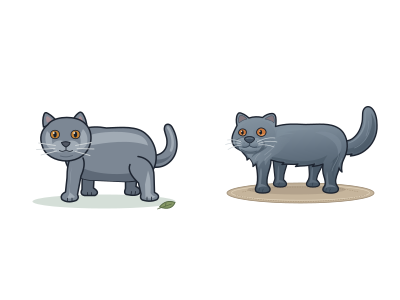
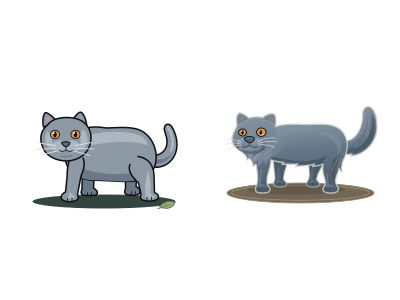
A Persian’s long coat covers a broad, compact body with short, strong legs and a short, bushy tail.
A shorter coat
Exotic Shorthairs have a Persian-like rounded head and compact body, but a shorter, dense coat that stands away from the skin.
Curls are not guaranteed
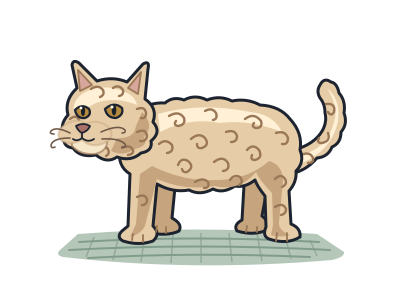
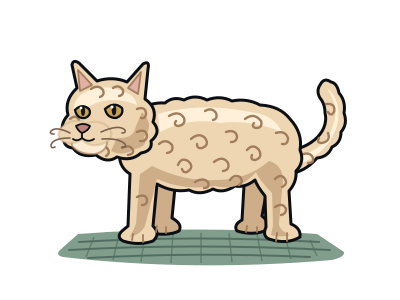
Selkirk Rexes can have short or long coats, and their whiskers can curl too. Straight-coated Selkirks also occur.
Explore this group
Study attribution
Gandolfi et al. (2018), Scientific Reports 8:7024 · CC-BY-4.0. Original explanation of study-specific similarity; editorial group headings are explicitly not clades or geography of origin. No study photos imported.
CFA, TICA and GCCF breed histories. Original summaries of documented breeding programmes and registry distinctions. Per-page sources identify the relevant breed histories; no standards, source prose or photographs reproduced.
Gandolfi et al. (2010): Sphynx and Devon Rex mutations in KRT71. Independent factual explanation of distinct coat variants, not a breed pedigree. No source imagery or text reproduced.
Selection Signatures Reveal Candidate Genes for the Cornish Rex Breed-Specific Phenotype (2024). Factual contrast between LPAR6-associated Cornish coat and KRT71-associated Devon/Sphynx coats. No figures or measurements copied.
Selected facts/group membership adapted; simplified layout and illustrations by Lifetree.