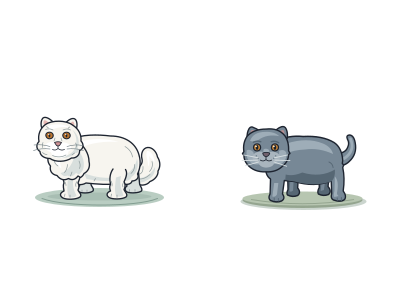
An exploration group
Persian, Exotic & Himalayan
Selected breed-development histories
Different coats, connected breeding histories
Branches combine study-specific genetic affinities and documented breed-development histories. They are browsing groups, not a complete pedigree or dated evolutionary tree. Crossbreeding connects different branches, and similar coats can arise independently.
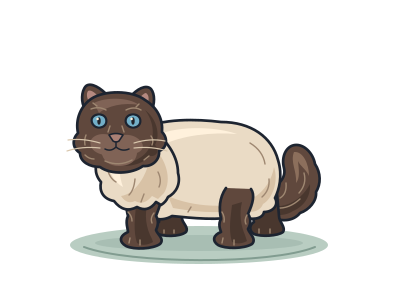
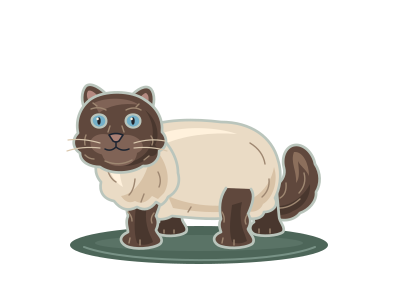
Return to the tree of life →Persian breeding history links these cats, even when their coats look different. The Exotic’s short coat developed through crosses involving Persians. Himalayan breeding programmes combined Persian and Siamese cats, aiming for long-haired cats with the Siamese colour pattern. These connections come from documented breeding programmes, not just a resemblance between cats.
The names also depend on which registry you follow. Registries are organisations that register cats and recognise breeds. CFA treats Himalayan as a colour division within Persian, while TICA lists Himalayan separately. That is a difference in how organisations classify cats. It does not make these cats separate biological species.
This browsing group brings those shared development histories together. It is not a complete family record or a timeline of breed origins. Neighbouring branches do not, by their position alone, show ancestors and descendants. Documented crosses still matter: the diagram’s limits do not erase the Persian connections behind Exotic and Himalayan development.
Crosses and returns
Exotic development included crosses between Persians and American Shorthairs. Cats descended from these crosses were then bred with Persians.
An experimental beginning
Cobb and Keeler began an experimental Himalayan breeding programme in 1931. Further development took place in several countries.
A familiar build
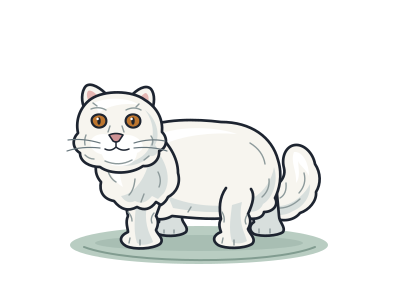
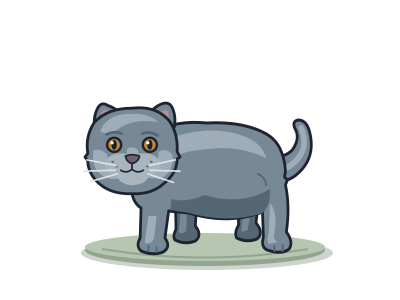
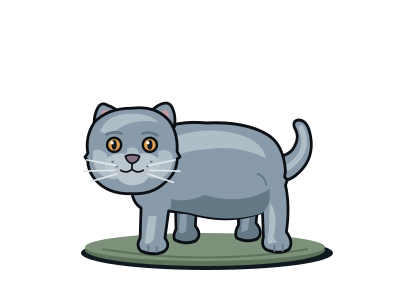
The Exotic has a dense coat and a compact, Persian-like build.
Explore this group
Study attribution
Gandolfi et al. (2018), Scientific Reports 8:7024 · CC-BY-4.0. Original explanation of study-specific similarity; editorial group headings are explicitly not clades or geography of origin. No study photos imported.
CFA, TICA and GCCF breed histories. Original summaries of documented breeding programmes and registry distinctions. Per-page sources identify the relevant breed histories; no standards, source prose or photographs reproduced.
Gandolfi et al. (2010): Sphynx and Devon Rex mutations in KRT71. Independent factual explanation of distinct coat variants, not a breed pedigree. No source imagery or text reproduced.
Selection Signatures Reveal Candidate Genes for the Cornish Rex Breed-Specific Phenotype (2024). Factual contrast between LPAR6-associated Cornish coat and KRT71-associated Devon/Sphynx coats. No figures or measurements copied.
Selected facts/group membership adapted; simplified layout and illustrations by Lifetree.