A domestic breed
Exotic Shorthair
Felis catus
A Persian-style cat with a plush, short coat
These are editorial browsing groups, informed by Gandolfi et al. 2018 genetic-structure analyses. They are not rooted clades, direct ancestry, or a map of breed origins. Admixture and incomplete sampling limit every grouping.
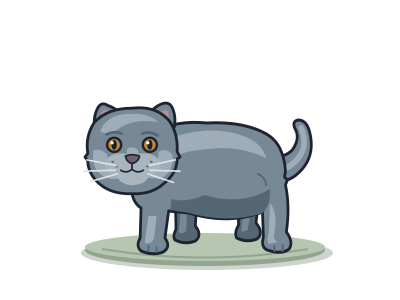
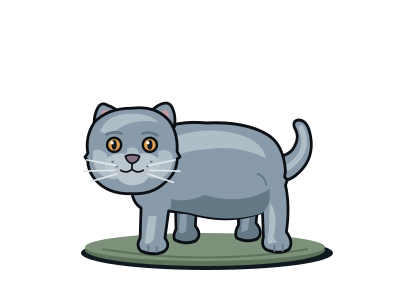
Return to the tree of life →The Exotic Shorthair shares the Persian’s broad, round head and sturdy body, but wears a short, plush coat instead of long, flowing fur. It is a domestic-cat breed, not a separate species or a wild “exotic” cat. Written breed standards seek the same head and body type as the Persian, with full cheeks, small round-tipped ears and short, strong legs.
Short fur does not mean a sleek outline. A dense layer underneath makes the coat stand away from the body. These cats come in many appearances, including solid colours, tabby stripes or spots, white patches and darker colouring on the face, ears, legs and tail.
The Exotic shares this branch with the Persian and Himalayan because of their connected breeding histories. Persian crosses helped establish the Exotic’s short-coated Persian type; Himalayan development combined Persian and Siamese features. The branch compares those routes, rather than showing the three breeds as successive ancestors and descendants.
Origins
The breed developed in the United States. The Cat Fanciers’ Association (CFA) traces its beginnings to West Coast breeders crossing Persians with American Shorthairs in the 1950s.
Original purpose
Early crosses aimed to bring Persian silver colouring and green eyes into American Shorthairs.
Recognition
Britain’s Governing Council of the Cat Fancy recognised the breed in 1986 and granted championship status in 1995. These were registry milestones, not its origin dates.
Study attribution
Gandolfi et al. (2018), Scientific Reports 8:7024 · CC-BY-4.0. Original explanation of study-specific similarity; editorial group headings are explicitly not clades or geography of origin. No study photos imported.
CFA, TICA and GCCF breed histories. Original summaries of documented breeding programmes and registry distinctions. Per-page sources identify the relevant breed histories; no standards, source prose or photographs reproduced.
Gandolfi et al. (2010): Sphynx and Devon Rex mutations in KRT71. Independent factual explanation of distinct coat variants, not a breed pedigree. No source imagery or text reproduced.
Selection Signatures Reveal Candidate Genes for the Cornish Rex Breed-Specific Phenotype (2024). Factual contrast between LPAR6-associated Cornish coat and KRT71-associated Devon/Sphynx coats. No figures or measurements copied.
Selected facts/group membership adapted; simplified layout and illustrations by Lifetree.