A domestic breed
Persian
Felis catus
A long coat, a round face and connections beyond appearances.
These are editorial browsing groups, informed by Gandolfi et al. 2018 genetic-structure analyses. They are not rooted clades, direct ancestry, or a map of breed origins. Admixture and incomplete sampling limit every grouping.
Return to the tree of life →The Persian is a domestic cat breed, not a separate species. In a 2018 study, sampled Persians showed genetic similarities to British Shorthairs, Selkirk Rexes and Scottish Folds. Despite their different looks, these breeds grouped together in the study’s results.
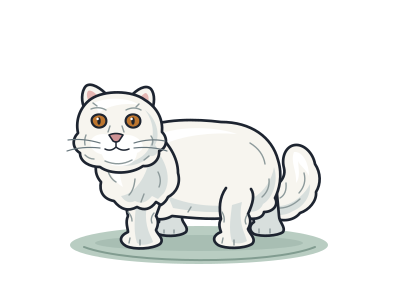
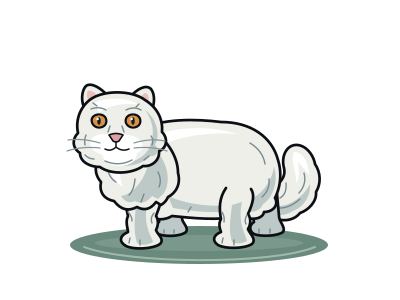
A Persian has a broad, round head, full cheeks and small, round-tipped ears. Its compact body rests on short, thick legs. Long fur forms a thick collar around the head and a flowing plume on the tail. White is only one possibility: Persians also have stripes, patches and other coat colours.
The smaller branch compares Persian, Exotic Shorthair and Himalayan histories. Breeders developed the Exotic’s short coat through crosses, while Persian–Siamese programmes produced the Himalayan’s pointed pattern. CFA now treats Himalayan as a Persian division; TICA lists it separately in the Persian breed group. These records explain the connections without making the diagram a full pedigree.
Origins
Selective breeding shaped the modern Persian. British breeders exhibited Persian Longhairs at London’s Crystal Palace show in 1871, but those cats looked different from today’s show Persians.
Original purpose
The documented early roles were companionship and exhibition. TICA describes Persians as pets in Victorian homes and participants in Britain’s early cat shows.
Recognition
The Persian was a foundation breed of the Cat Fanciers’ Association in 1906. This marks registry recognition, not the breed’s origin.
Study attribution
Gandolfi et al. (2018), Scientific Reports 8:7024 · CC-BY-4.0. Original explanation of study-specific similarity; editorial group headings are explicitly not clades or geography of origin. No study photos imported.
CFA, TICA and GCCF breed histories. Original summaries of documented breeding programmes and registry distinctions. Per-page sources identify the relevant breed histories; no standards, source prose or photographs reproduced.
Gandolfi et al. (2010): Sphynx and Devon Rex mutations in KRT71. Independent factual explanation of distinct coat variants, not a breed pedigree. No source imagery or text reproduced.
Selection Signatures Reveal Candidate Genes for the Cornish Rex Breed-Specific Phenotype (2024). Factual contrast between LPAR6-associated Cornish coat and KRT71-associated Devon/Sphynx coats. No figures or measurements copied.
Selected facts/group membership adapted; simplified layout and illustrations by Lifetree.