A domestic breed
Selkirk Rex
Felis catus
A curly-coated cat with documented Persian connections
These are editorial browsing groups, informed by Gandolfi et al. 2018 genetic-structure analyses. They are not rooted clades, direct ancestry, or a map of breed origins. Admixture and incomplete sampling limit every grouping.
Return to the tree of life →The Selkirk Rex sits near Persians, Exotic Shorthairs and British Shorthairs in this browsing tree. There is a real historical connection: all three breeds were used in its development. But the diagram itself does not establish that history. Its editorial groups reflect selected genetic similarities. They are not a family tree showing neighbouring breeds as ancestors and descendants, or a map of where breeds began.
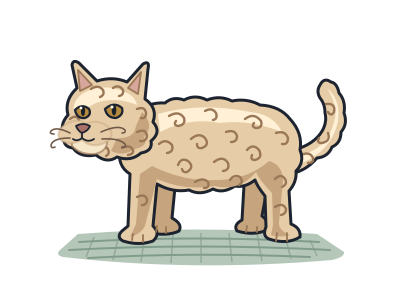
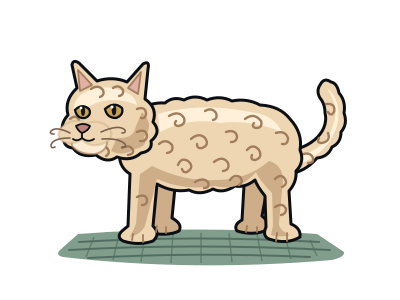
Curls are this breed’s best-known feature, and even its whiskers and eyebrows can curl. Yet not every Selkirk Rex has a curly coat. Research linked the curls to a change in a gene involved in hair formation. The curly-coat trait can appear when a cat inherits just one copy of the associated change.
There is no single Selkirk Rex colour: all coat colours and patterns are allowed. The curly adult coat can keep developing until about two years of age. So a young cat’s coat may not yet show its fully developed curls.
Origins
The breed began with Miss DePesto, a curly-coated kitten from Montana, USA, taken in by Persian breeder Jeri Newman.
Original purpose
Development focused on appearance: keeping the unusual curls while adding a round, sturdy body and other desired features.
Recognition
The Cat Fanciers’ Association accepted the breed for registration in 1992 and championship competition in 2000. These were recognition milestones, not origin dates.
Study attribution
Gandolfi et al. (2018), Scientific Reports 8:7024 · CC-BY-4.0. Original explanation of study-specific similarity; editorial group headings are explicitly not clades or geography of origin. No study photos imported.
CFA, TICA and GCCF breed histories. Original summaries of documented breeding programmes and registry distinctions. Per-page sources identify the relevant breed histories; no standards, source prose or photographs reproduced.
Gandolfi et al. (2010): Sphynx and Devon Rex mutations in KRT71. Independent factual explanation of distinct coat variants, not a breed pedigree. No source imagery or text reproduced.
Selection Signatures Reveal Candidate Genes for the Cornish Rex Breed-Specific Phenotype (2024). Factual contrast between LPAR6-associated Cornish coat and KRT71-associated Devon/Sphynx coats. No figures or measurements copied.
Selected facts/group membership adapted; simplified layout and illustrations by Lifetree.